Planning a summer drive out of Salinas sounds simple until you remember what local roads are really like. You can leave cool morning fog near the coast, hit stop and go traffic on Highway 101, and end up in much hotter inland conditions a short time later. In Salinas alone, there were 418 traffic accidents resulting in injury or death in 2024, and speeding contributed to 109 of them, which shows how quickly a normal drive can turn serious when a vehicle or driver is not fully ready (SWITRS summary via Mercado Kramer, 2024, https://www.mercadokramer.com/salinas-car-accident-lawyer/statistics/).
If you want a practical version of what Salinas drivers should check before summer road trips, start with the basics that prevent breakdowns and close calls. Tires, brakes, battery, visibility, and alignment matter more than convenience items. Monterey County summer driving also adds local factors that generic checklists miss, especially fog, tourist traffic, Highway 1 curves, and the wear that coastal air puts on paint and exposed metal.
1. Tire Condition and Pressure Check
Start at the four corners of the car. Tires are still the most common place I tell drivers to slow down and take a better look, because a tire can seem fine in the driveway and still be a problem halfway through a hot afternoon drive.
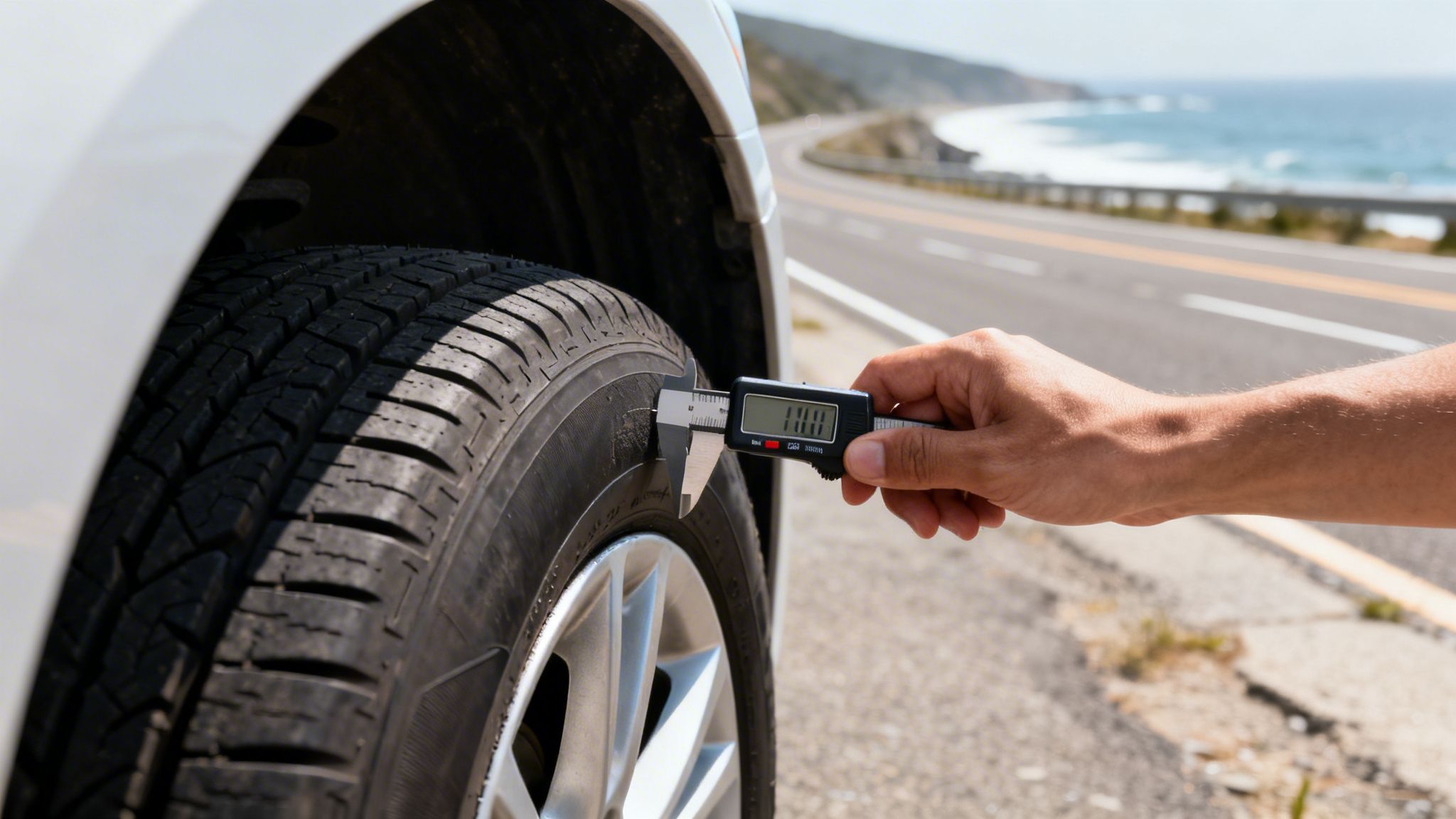
NHTSA says to inspect tires monthly and before trips for tread damage, cuts, punctures, bulges, or uneven wear, and the legal minimum tread depth is 2/32 inch (NHTSA, 2024, https://www.nhtsa.gov/summer-driving-tips). That minimum may be legal, but it is not where I want a customer starting a summer road trip, especially if the route includes Highway 1, rough shoulders, or long hours on 101.
What to inspect before you leave
Check pressure first thing in the morning, before the tires heat up. Use the pressure listed on the driver’s door jamb, not the maximum printed on the tire sidewall.
Look for wear patterns too.
- Outer edge wear: Usually points to underinflation or alignment issues.
- Center wear: Often means overinflation.
- One-sided wear: Can signal suspension or alignment trouble.
- Bulges or sidewall cracking: Replace the tire. Don’t gamble on it.
The penny test is useful for a quick driveway check. If Lincoln’s head is fully visible, the tire is worn past the point where it should be trusted for a summer trip.
If your trip starts in cool Salinas air and heads inland, check pressures before you leave, not after the first fuel stop. Heat changes the reading and can hide the true baseline.
A portable compressor and a good digital gauge are worth keeping in the car. They do not replace a sound tire, but they can save a trip when pressure drops unexpectedly.
2. Brake System Inspection
Brakes do not usually fail all at once without warning. Most cars give you signs first, and summer driving makes those signs more important, not less.

If you hear squealing, feel vibration through the pedal, notice the car pulling, or feel the pedal going soft, get it checked before you head out. Stop and go traffic, downhill grades, and heavy summer loads all put more demand on the system.
What works and what does not
What works is a real inspection. Pad thickness, rotor condition, brake fluid condition, and overall pedal feel need to be checked by someone who knows what normal looks like on your vehicle.
What does not work is assuming the brakes are fine because they still stop the car around town. A brake issue that feels manageable on local errands can get much worse on a long descent or in dense highway traffic.
I also tell drivers not to ride the brakes on long grades. Downshift when appropriate and let the drivetrain help control speed. That keeps heat down and helps preserve stopping power.
If a repair estimate changes after teardown because hidden damage is found, that is normal in some repair situations. Searson explains that clearly in this guide on why a repair estimate can go up after work starts.
3. Fluid Levels and Condition Check
Fluids are easy to ignore because they are out of sight. They are also one of the fastest ways a simple summer drive turns into an overheated engine, transmission trouble, or poor visibility.
Check engine oil, coolant, brake fluid, transmission fluid if your vehicle has a serviceable dipstick, and windshield washer fluid. Do it on level ground, and check coolant only when the engine is cold.
What I would not skip
- Engine oil: Low oil is hard on any engine, especially in heat.
- Coolant: Summer traffic and long grades expose weak cooling systems fast.
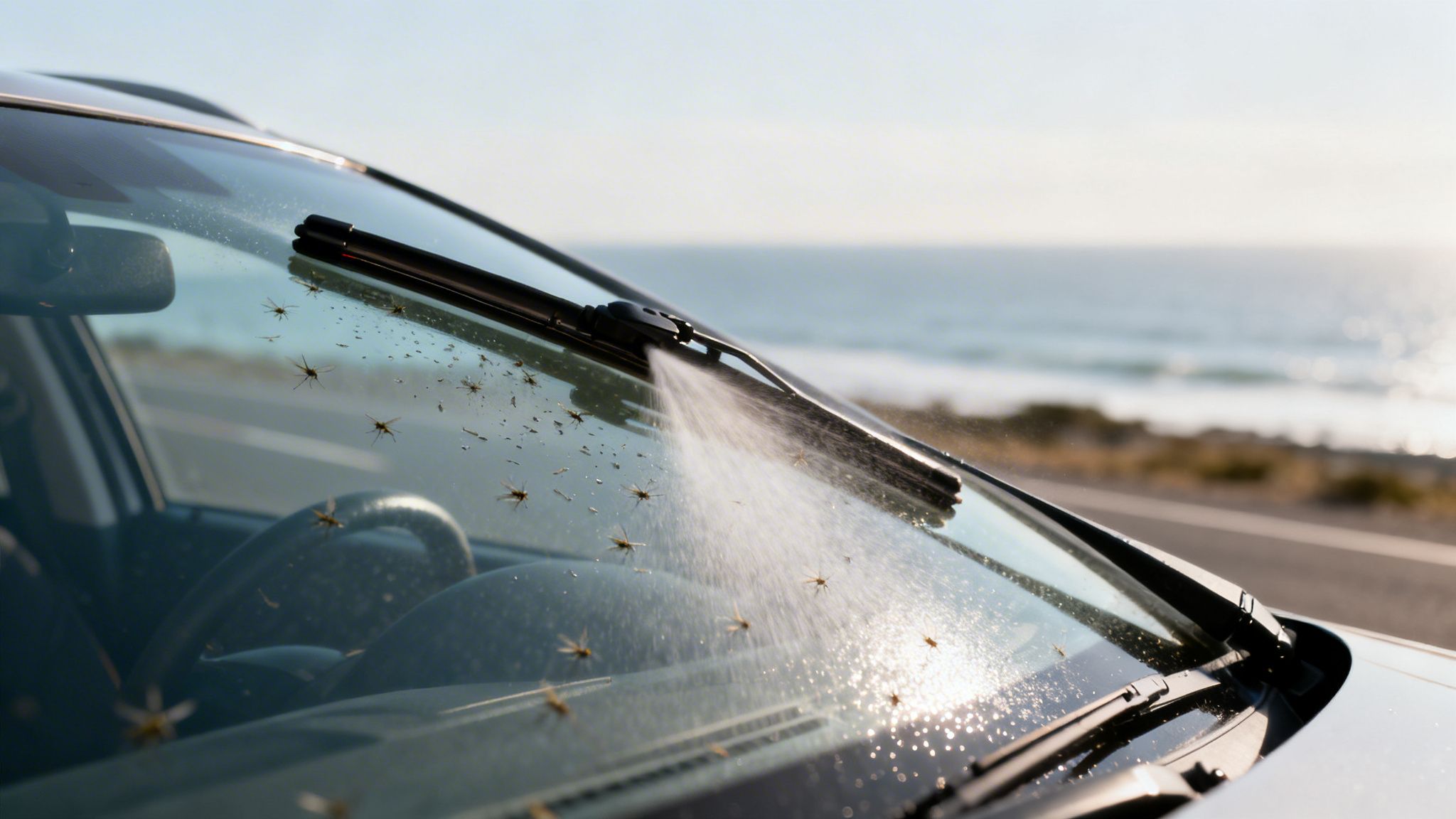
- Washer fluid: Highway bugs, dust, and grime can ruin visibility in a hurry.
- Leaks under the car: Small stains matter. They rarely fix themselves.
California’s road safety picture is serious enough that basic readiness should not be treated as optional. NHTSA projections estimated over 4,400 fatalities in California motor vehicle crashes in 2022, about 12 deaths daily (NHTSA, 2024, https://www.nhtsa.gov/sites/nhtsa.gov/files/2024-05/CA%20FY23%20Annual%20Report-tag.pdf). That does not mean every road trip is dangerous. It means neglect is a bad bet.
A common mistake is topping off whatever looks low without confirming the correct fluid. Mixing the wrong coolant, for example, can create bigger problems than low coolant alone.
4. Battery Health and Electrical System Check
A weak battery shows up at the worst possible time. Usually that means when the car is packed, the family is ready, and you are already behind schedule.
Maaco recommends testing batteries over three years old before summer trips, and notes that batteries lose 20 to 30 percent capacity above 77°F (Maaco, 2024, https://www.maaco.com/blog/summer-road-trip-preparation-checklist/). Heat is hard on batteries. It shortens the margin you thought you had.
Simple checks that help
Open the hood and inspect the terminals. If you see corrosion, clean it carefully and make sure the cable connections are tight.
Then get the battery load tested. Many parts stores will do that for you. A visual inspection alone is not enough, because plenty of batteries look acceptable right up until they fail under load.
Healthy batteries typically read 12.6 volts at rest. During cranking, you want to see the battery stay at 9.6 volts or above under proper test conditions. Most drivers do not need to perform that test themselves, but they should know why a proper battery test matters.
A battery can start fine in your driveway and still strand you later after heat soak, fuel stops, and heavy A/C use. That is why testing matters more than guessing.
If your vehicle has newer driver assistance features and the battery is replaced, ask whether any system checks or recalibration are needed afterward.
5. Air Conditioning Performance
This one is partly about comfort, but not only comfort. A working A/C system also helps clear interior moisture and keep windows from fogging when the marine layer rolls in.
Monterey Bay driving is different from inland driving because your visibility can change fast. A car that cools poorly in the afternoon often struggles to defog properly in cool coastal conditions too.
What to pay attention to
Start the car and run the A/C for a few minutes. You want steady cold air, strong airflow, and no odd noises from the compressor area.
If the airflow is weak, check the cabin air filter first. A clogged filter can make the system feel much worse than it really is.
If the air is not getting cold enough, do not assume it just needs a quick recharge. Low refrigerant usually means there is a leak somewhere. Temporary fixes tend to become repeat problems.
For local drivers, this matters on routes where coastal fog can appear quickly. If your defogging performance is weak in the driveway, it will not get better on Highway 1.
6. Lights, Wipers, and Windshield Integrity
Visibility problems stack up fast. Fog, low evening sun, insect buildup, dirty glass, weak wipers, and a small windshield chip can all seem minor on their own. Together, they make a bad driving situation.
One background issue local drivers know well is summer marine fog on the coast. Conditions around Highway 1 can cut visibility sharply during the season, so working lights and clean glass matter more than people think before they leave.
Check all three together
Do not just glance at the headlights and move on. Turn on the full lighting system and verify:
- Headlights and high beams: Both sides working, lenses not badly hazed.
- Brake lights and turn signals: Have someone stand behind the vehicle and confirm.
- Fog lights if equipped: Useful for local coastal driving when visibility drops.
- Wiper blades: Replace them if they streak, chatter, or smear.
- Windshield chips: Fix small chips before temperature swings spread them.
Clean the inside of the windshield too. That makes a bigger difference with glare than many drivers realize.
I have seen plenty of drivers spend money on big trip prep and ignore a cracked blade or a spreading chip. That is backwards. You need to see clearly first.
7. Emergency Kit and Documentation
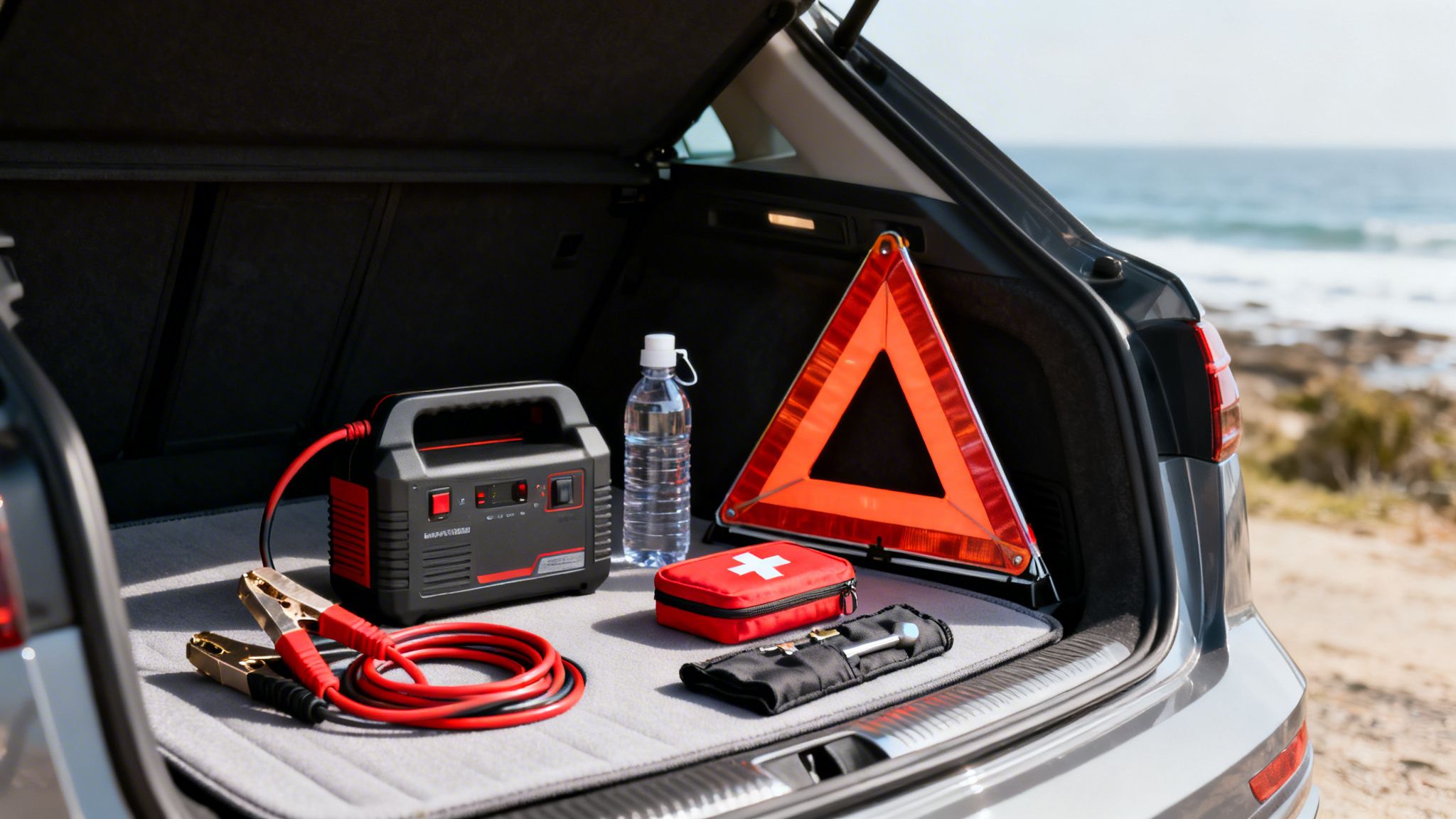
A good emergency kit is not overkill. It is what turns a roadside problem into an inconvenience instead of a full day gone wrong.
Cell service can get spotty in parts of Monterey County, and even when service is fine, it helps to have the basics within reach. Keep the kit where you can get to it without unloading the whole trunk.
What belongs in the car
- Spare tire and jack tools: Check them before the trip, not after the flat.
- Phone cable and power bank: Dead phone, dead map, dead contact list.
- Water and basic supplies: Useful for people first, vehicle second.
- Jumper cables or jump pack: Especially smart if the battery is aging.
- Insurance card and registration: Keep current copies in the vehicle.
If you need local repair help after a crash or body damage while traveling through town, Searson’s page on auto collision repair in Salinas gives a clear overview of the kind of support available.
One more practical point. Put important numbers in your phone before you leave, not after something happens.
8. Alignment and Suspension Check
When alignment is off, drivers usually describe it the same way. The car feels a little annoying, a little tired, and a little harder to keep straight. On a road trip, that small annoyance becomes fatigue.
If the steering wheel is crooked, the car pulls, or the tires show uneven wear, have the alignment checked. That is especially true if you hit a pothole, curb, or road debris recently.
Why this matters more after prior damage
Salinas has used traffic calming devices over the past decade, and city engineer Gerardo Rodriguez reported an approximate 14 percent reduction in 85th percentile speeds after Traffic Logix speed cushion installations, with zero resident complaints post-installation (Mercado Kramer summary of local reporting, 2024). Slower speeds help. They do not erase the need for a car to track straight and respond predictably.
Suspension and alignment issues also matter after collision repair. A vehicle can look fine and still be off underneath. If the car had prior structural, wheel, or suspension damage, confirm that the repair addressed geometry properly and that the vehicle drives as it should.
If you need local help with that kind of concern, Searson’s alignment and suspension service in Salinas explains the basics.
On Highway 101, a car that drifts or pulls is not just annoying. It wears out the driver, and tired drivers make slower corrections.
9. Check for Existing Dents, Scratches, and Chips
A lot of people treat paint damage as a problem for another day. Around Salinas and the Monterey Bay Area, that is a mistake.
Coastal air, morning moisture, and summer sun are hard on exposed metal. A small chip on the hood or a scratch at a door edge may still look minor now, but once the paint seal is broken, corrosion gets a starting point.
Cosmetic does not always stay cosmetic
Walk around the vehicle before your trip and look closely at the front edge of the hood, roofline, door edges, and around wheel openings. Those are common places for chips and small damage to start showing up.
If the damage is tiny, touch-up paint may help seal it for the short term. If the scratch is through the paint, or if you already see discoloration, get it looked at properly.
This is especially true for vehicles that spend time near the coast. Salt air does not care whether the damage came from a shopping cart, a rock chip, or an old repair edge.
If you want a professional look at minor body damage before the season gets busy, Searson offers dent and scratch removal in Salinas.
10. Review Your Insurance Policy
This is the least mechanical item on the list, but it saves real stress. A five minute policy review before a trip is better than trying to figure out coverage on the shoulder after an accident.
Check whether you carry collision, non-collision damage coverage, roadside assistance, and rental reimbursement. Make sure your insurance card is current in both paper and digital form.
Know your practical options before you need them
California drivers should also remember that policy guidance from an insurer is not the same thing as your only choice. If your vehicle needs collision repair, it helps to understand your options before you are under pressure.
Families also need to think about restraints before long trips. In California, unrestrained passenger vehicle occupant fatalities rose 12.2 percent from 782 in 2020 to 878 in 2021 (NHTSA, 2024, https://www.nhtsa.gov/sites/nhtsa.gov/files/2024-05/CA%20FY23%20Annual%20Report-tag.pdf). Before any summer trip, make sure every belt latches properly and every child restraint is installed correctly.
If you want help understanding the repair side of a claim, Searson’s page on auto insurance assistance in Salinas is a useful starting point.
10-Point Pre-Trip Vehicle Check for Salinas Drivers
| Item | Implementation 🔄 (Complexity) | Resources ⚡ (Requirements) | Expected Outcomes ⭐ (Effectiveness) | Ideal Use Cases 📊 (When to use) | Key Advantages & Tips 💡 |
|---|---|---|---|---|---|
| 1. Tire Condition and Pressure Check | Low 🔄: basic visual & gauge checks | Moderate ⚡: tire gauge, tread tool, compressor/plug kit | High ⭐⭐⭐⭐: prevents blowouts, improves fuel economy | Pre-trip, long highway or mountain drives | Prevents failures; check PSI in AM; use manufacturer PSI; carry compressor |
| 2. Brake System Inspection | Moderate–High 🔄: visual ok, full check needs technician | Moderate ⚡: pads/rotors/tools, brake fluid service | Very High ⭐⭐⭐⭐⭐: ensures stopping power and safety | Mountain descents, heavy traffic, pre-trip safety | Detects wear early; listen for squeal; avoid riding brakes; get certified inspection |
| 3. Fluid Levels and Condition Check | Low 🔄: dipstick/visual checks; some sealed systems | Low ⚡: correct fluids, funnel, owner manual | High ⭐⭐⭐⭐: prevents overheating/transmission damage | Older vehicles, long hot-weather trips | Check cold on level ground; carry extra oil/coolant; follow manual specs |
| 4. Battery Health and Electrical System Check | Moderate 🔄: terminal cleaning simple; diagnostics need tester | Moderate ⚡: multimeter, terminal brush, shop battery test | High ⭐⭐⭐⭐: reduces risk of being stranded | Vehicles >3 yrs, remote routes, hot climates | Test battery, clean terminals, replace >3 yrs, carry jumper or jump starter |
| 5. Air Conditioning (A/C) System Performance | Moderate–High 🔄: basic check DIY; recharge/repair requires pro | Moderate ⚡: cabin filter, refrigerant service, technician | Medium–High ⭐⭐⭐: improves comfort and defogging | Hot inland routes, coastal fog, long trips | Test early; replace cabin filter; service leaks professionally |
| 6. Lights, Wipers, and Windshield Integrity | Low 🔄: simple bulb/wiper swaps; chip assessment | Low ⚡: replacement bulbs, wiper blades, repair kit/pro | High ⭐⭐⭐⭐: maintains visibility and safety | Night driving, fog, coastal/dusty roads | Replace wipers 6–12 months; repair chips promptly; clean inside glass |
| 7. Emergency Kit and Documentation | Low 🔄: assemble & periodic checks | Low ⚡: jump starter, spare/tire tools, first-aid, docs | High ⭐⭐⭐⭐: increases self-sufficiency and safety | Remote stretches, low cell-signal areas, long trips | Include power bank, insurance contact, check expirations, accessible storage |
| 8. Alignment and Suspension Check | High 🔄: specialized equipment and calibration | High ⚡: alignment rack, trained technician, ADAS tools | High ⭐⭐⭐⭐: improves handling, tire life, stability | Winding coastal roads, after impacts or hitting potholes | Check annually or after impact; verify ADAS calibration post-repair |
| 9. Check for Existing Dents, Scratches, and Chips | Low–Moderate 🔄: visual inspect DIY; repairs vary | Low ⚡: touch-up paint, wax; pro for larger repairs | Medium ⭐⭐⭐: prevents rust and preserves value | Coastal/salt-air environments, post-minor damage | Wash & wax before trip; use touch-up paint; seek pro for big chips |
| 10. Review Your Insurance Policy | Low 🔄: paperwork review and calls | Low ⚡: policy docs, phone, agent contact | High ⭐⭐⭐⭐: clarifies coverage, speeds claims | Before long trips or unfamiliar routes | Keep digital/paper ID; program claims number; know right to choose shop |
FAQ
Q: How far ahead of a summer trip should I inspect my car?
A: A week or two ahead is better than the night before. That gives you time to handle tires, brakes, a weak battery, or a windshield chip without rushing. If the car already has known issues, check it even earlier.
Q: What matters most if I only have time for a few checks?
A: Start with tires, brakes, battery, lights, and fluids. Those are the areas most likely to affect whether you get there safely and whether the car can handle heat, traffic, and long hours on the road.
Q: Do I need to worry about fog in summer around Monterey County?
A: Yes. Local summer driving is not just bright sun and dry pavement. Coastal fog can reduce visibility quickly, so lights, wipers, glass condition, and defog performance all deserve attention before a trip.
Q: Is a small paint chip really worth fixing before a road trip?
A: In this area, yes. Coastal moisture and salt air can make a small chip turn into a rust problem faster than many drivers expect. If bare metal is exposed, it is better to seal or repair it sooner.
Q: Should I replace my battery before a trip if it seems okay?
A: Not automatically, but if it is older or you have noticed slower starts, have it load tested. Batteries often fail without much warning in hot weather, and testing is more reliable than guessing.
Q: What should I do if my car was repaired after a past collision?
A: Pay attention to alignment, suspension feel, warning lights, and any driver assistance features. If the car does not track straight or something feels off, get it checked before your trip rather than assuming it is normal.
Drive with Confidence This Summer
This checklist is not about chasing perfection. It is about handling the issues that leave drivers stranded, worn out, or dealing with damage that could have been prevented.
That matters even more here, because what Salinas drivers should check before summer road trips is shaped by local conditions, not a generic national list. Monterey County drivers deal with Highway 101 traffic, coastal moisture, changing temperatures, inland heat, and stretches of road where a small vehicle problem gets bigger fast.
The goal is peace of mind. If the tires are sound, the brakes feel right, the battery tests well, the lights work, and the car tracks straight, you have already taken care of the items that do the most to protect your trip.
I would also not ignore old cosmetic damage before summer travel. Around the Monterey Bay Area, scratches and chips are more than an appearance issue once coastal air gets to exposed metal. Fixing a small problem early is usually simpler than repairing rust later.
For families, visibility and restraint checks deserve extra attention. Clear glass, good wipers, working A/C for defogging, and seat belts that latch and retract properly all matter every mile of the drive.
If the vehicle has prior collision history, be more careful, not less. Confirm it drives correctly, look for uneven tire wear, and do not brush off warning lights or steering changes. Summer travel puts more demand on every system.
Searson Collision Center has been serving Salinas and the Monterey Bay Area since 1963, and that local experience matters. Coastal conditions, tourist traffic, and the way this region uses vehicles are different from what shops see in inland markets. If you have concerns about body damage, paint damage, frame issues, or alignment before your trip, it is worth getting a straight answer before the season gets busier.
Call us at (831) 422-2460 or stop by for a free estimate at 488 Brunken Ave, Salinas, CA 93901. We’re open Monday through Friday, 7:00 AM to 5:00 PM.
Sources
Mercado Kramer. "Salinas Car Accident Statistics." 2024. https://www.mercadokramer.com/salinas-car-accident-lawyer/statistics/
National Highway Traffic Safety Administration. "California FY23 Annual Report." 2024. https://www.nhtsa.gov/sites/nhtsa.gov/files/2024-05/CA%20FY23%20Annual%20Report-tag.pdf
National Highway Traffic Safety Administration. "Summer Driving Tips." 2024. https://www.nhtsa.gov/summer-driving-tips
Maaco. "Summer Road Trip Preparation Checklist." 2024. https://www.maaco.com/blog/summer-road-trip-preparation-checklist/
If you’re getting ready for summer travel and want a second set of eyes on your vehicle’s body, paint, alignment, or prior collision repairs, Searson Collision Center is here to help. We offer free estimates, straightforward answers, and local experience that comes from serving Salinas and the Monterey Bay Area for decades. Call (831) 422-2460 or visit us at 488 Brunken Ave, Salinas, CA 93901, Monday through Friday, 7:00 AM to 5:00 PM.