AI Answer: While not always legally required for minor accidents, getting a police report is strongly recommended. It serves as official, impartial evidence that documents key details like fault, damages, and witness information. This documentation can significantly speed up the insurance claim process, prevent the other driver from changing their story, and reduce the chances of your claim being delayed or denied, especially in cases involving injuries, a hit-and-run, or a dispute over who was at fault.
After a car accident, your mind is racing with questions about what to do next. If you're wondering, "do I need a police report for an insurance claim," you've come to the right place. Let's get straight to the answer.
The Short Answer on Police Reports and Insurance Claims
The simple truth is this: while a police report isn't always legally required for a tiny fender-bender here in California, getting one is always a good idea. We have seen this proven time and again in our Salinas shop.
Think of that report as the most powerful, impartial piece of evidence you can have. An officer's official account helps lock in the facts, prevents the other driver from changing their story later, and can dramatically speed up the entire insurance claim process. It's a key part of the puzzle, and we can provide expert auto insurance assistance in Salinas to help you put all the pieces together.
Why a Police Report Is Your Strongest Ally with Insurers
With over 60 years of experience helping drivers in the Monterey Bay Area, we've learned one thing: a police report is the single most powerful tool you can have when filing an insurance claim.
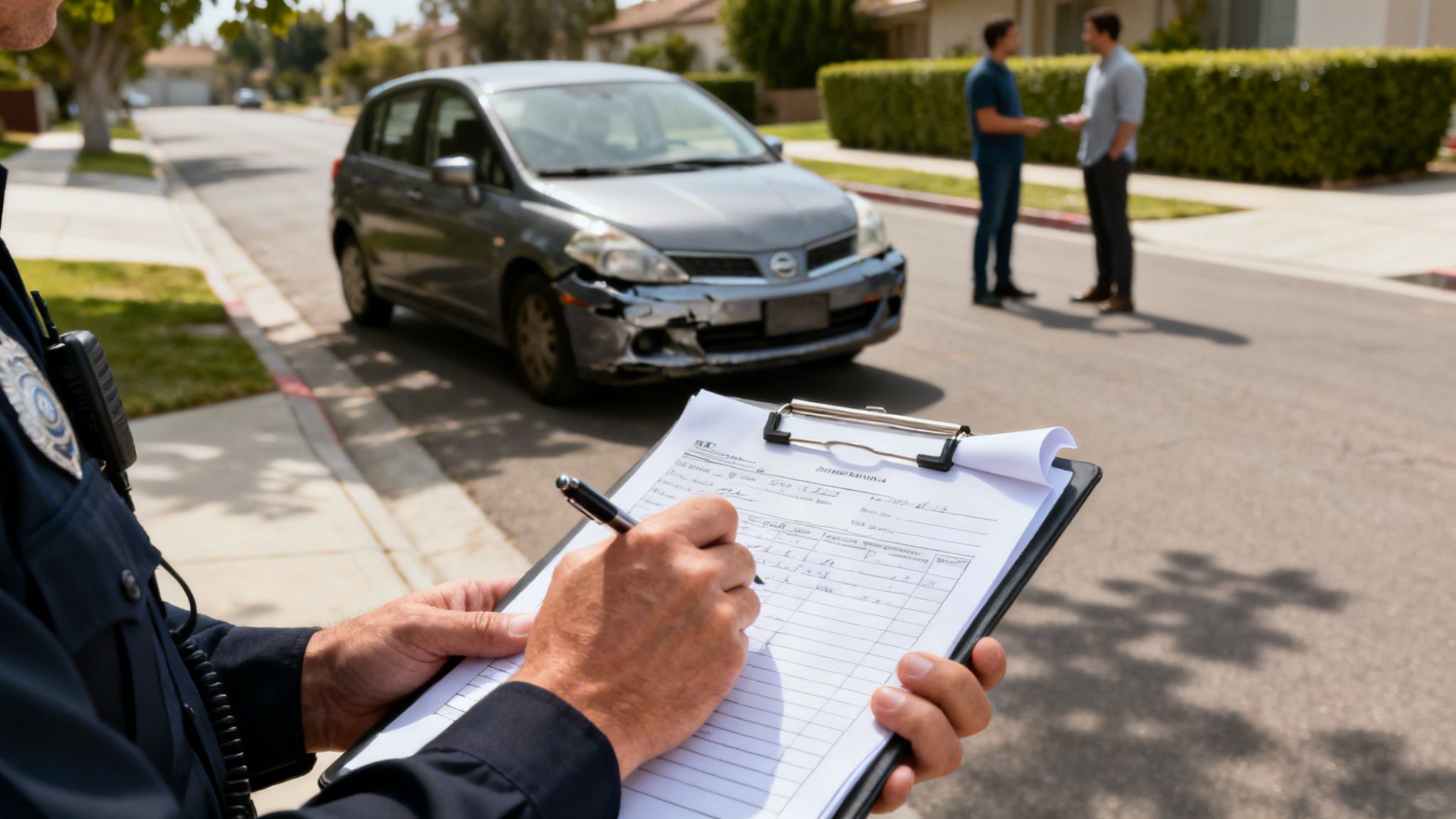
When an insurance adjuster has an official report, it cuts through confusion and finger-pointing. The officer's objective narrative and diagrams create a factual foundation that almost always leads to faster decisions and a smoother approval for your repairs.
The Power of Official Documentation
An insurance adjuster’s primary job is to evaluate facts and determine liability. A police report gives them a trusted, third-party account that is difficult to argue with.
Without one, your claim can quickly become a "he-said, she-said" stalemate. This forces the adjuster to launch a deeper investigation, which slows everything down.
Reducing Claim Delays and Denials
A police report dramatically strengthens your case, even for minor incidents. In fact, more than 30% of all traffic crashes nationwide result in an injury, making documentation critical (NHTSA, 2024).
Here’s why it makes such a difference:
- It Establishes Credibility: It shows the insurance company that you took the incident seriously.
- It Documents Key Details: It contains names, insurance information, witness contacts, and a diagram of the scene.
- It Discourages False Claims: It makes it much harder for the other driver to change their story.
Without that official document, the entire burden of proof lands on your shoulders. This can also invite more scrutiny over repair costs, touching on why repair estimates can sometimes change after work begins.
When You Absolutely Must Get a Police Report
Getting a police report is almost always a good idea. But there are certain times when it moves from being a "good idea" to being absolutely non-negotiable.
These are the situations where not having an official record can create serious financial and legal trouble. Do not let another driver talk you out of it; insisting on a report is the single most important thing you can do to protect yourself.
Situations That Demand a 911 Call
After any accident, your first priority is safety. Once everyone is out of harm's way, assess the situation. If any of the following apply, call the police immediately.
Any Injury or Fatality: This is the most critical. Adrenaline can mask serious injuries that only appear hours or days later.
A Suspected DUI: If you smell alcohol or the other driver seems impaired, call the police. An officer is the only one who can properly handle the situation.
A Hit-and-Run: If the other driver flees, you have a criminal situation, not just an insurance claim. A police report is essential for using your uninsured motorist coverage.
An Uncooperative or Uninsured Driver: If the other party won't share their license or insurance info, get an officer on the scene.
Significant Vehicle or Property Damage: If damage to any vehicle is serious, or if public property was hit, you need a report to sort out liability.
Police Report Checklist: When to Call for Help
| Accident Scenario | Is a Police Report Essential? | Why It Matters for Your Claim |
|---|---|---|
| Injuries or Death | Yes, always. | Creates an official record of harm, which is crucial for any personal injury claim and for establishing the severity of the incident. |
| Suspected DUI Driver | Yes, immediately. | An officer's assessment is the only way to officially document impairment, which strongly supports your claim that the other driver was at fault. |
| Hit-and-Run | Yes, absolutely. | A police report is usually required to use your uninsured/underinsured motorist coverage and proves you were the victim of a crime. |
| Uninsured/Uncooperative Driver | Yes. | Documents the other driver's failure to comply with the law, preventing them from changing their story later. |
| Major Damage | Yes. | Provides an unbiased account of significant damage to vehicles or property, which is vital for complex and high-cost claims. |
When in doubt, making the call is the safest bet for protecting your interests. This visual guide shows just how much a police report can affect the speed of your claim.
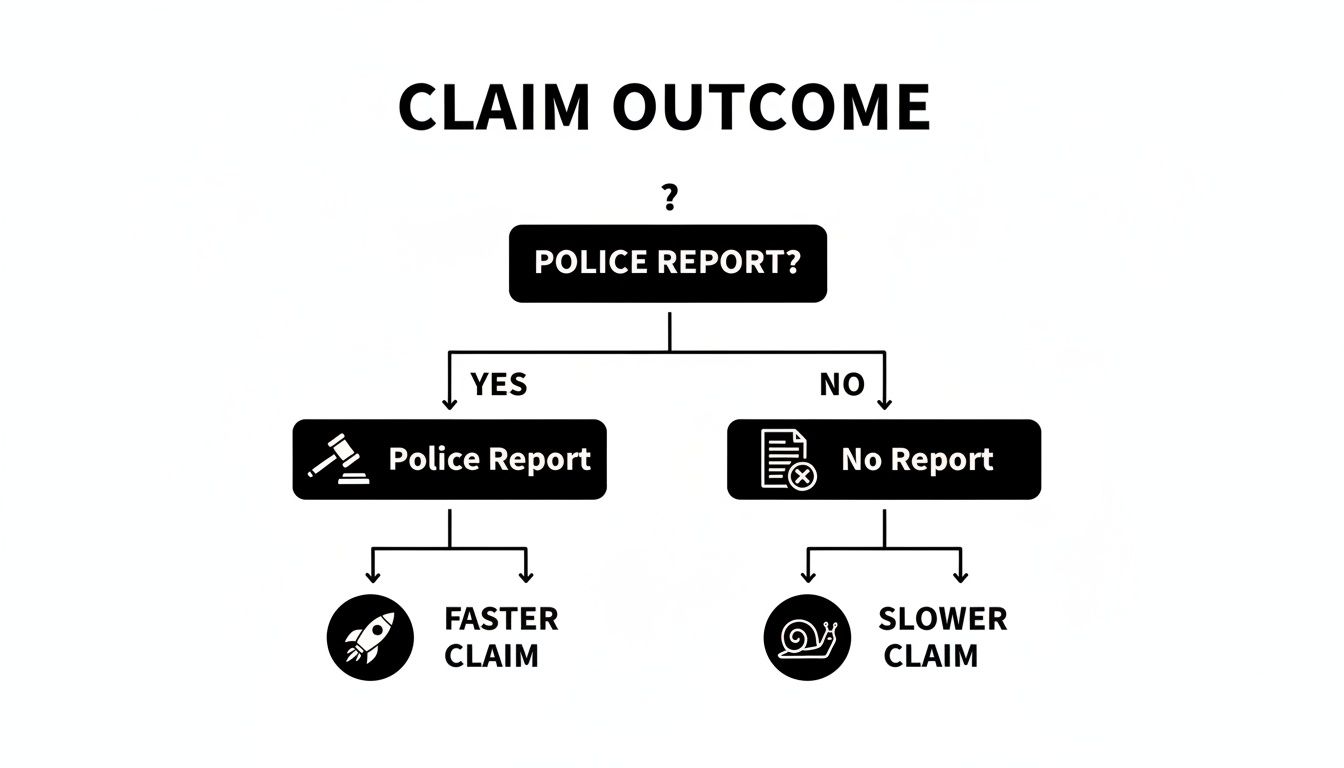
As you can see, having that official report is a green light for a smoother process. Going without one often means hitting every red light along the way.
California's SR-1 Reporting Requirement
Here in California, you also must file a Report of Traffic Accident Occurring in California (SR-1) form with the DMV within 10 days if the crash caused:
- Any injuries or death, no matter how minor.
- More than $1,000 in property damage to any single person.
A police report provides the credible, unbiased details you need to fill out the SR-1 form accurately. Failing to submit an SR-1 when required can result in the suspension of your driver's license (California DMV).
Filing a Claim Without a Police Report
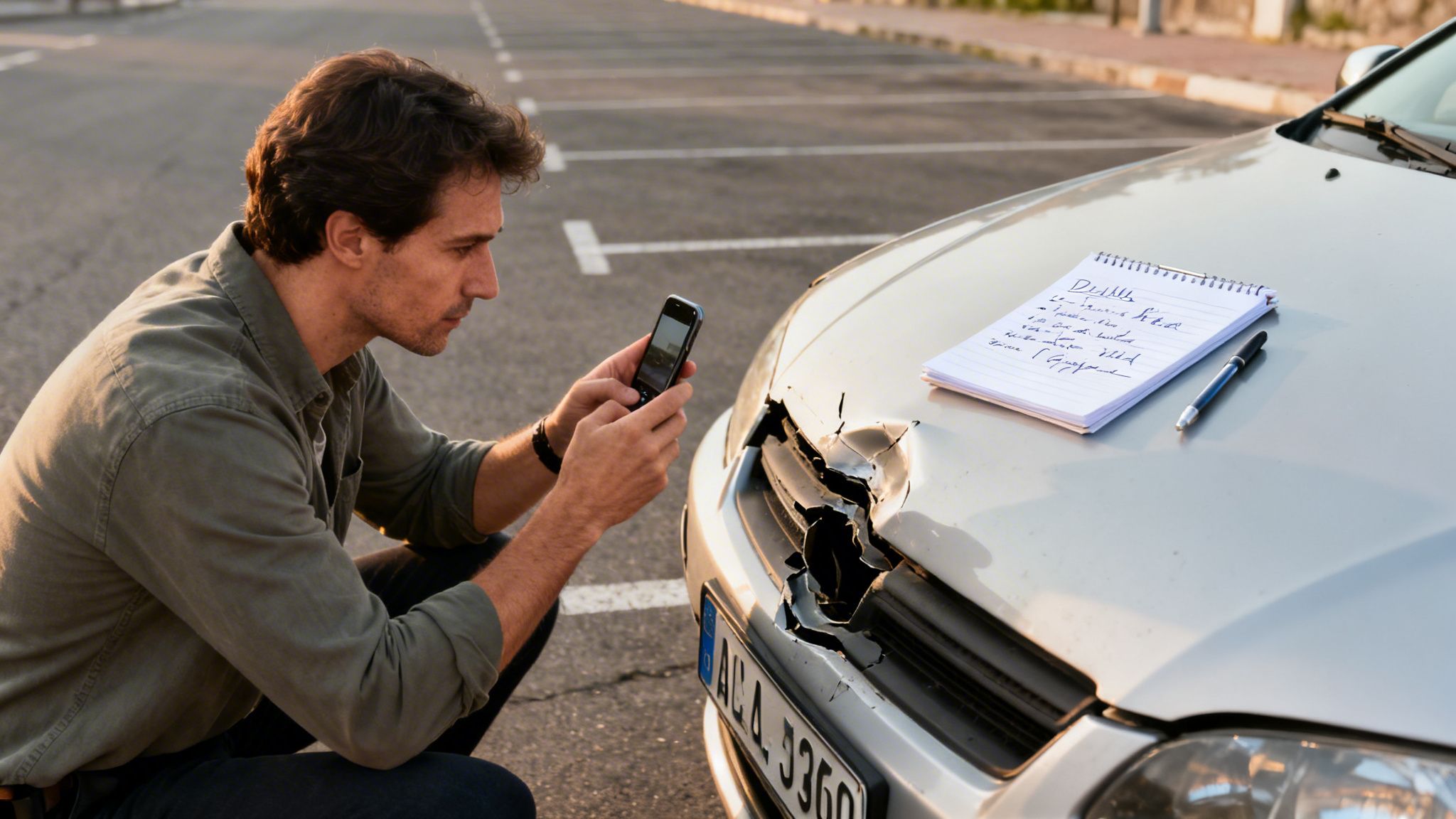
So, you were in a minor accident and didn't call the police. Don't panic. You can absolutely still file an insurance claim.
Without an official report, however, it’s now entirely up to you to paint a clear, convincing picture of what happened. The quality of the evidence you gather is critical.
What to Do at the Scene
Your smartphone is your most important tool. You need to capture everything you can, right then and there, before the scene changes and memories fade.
- Photos, and Lots of Them: Get pictures of the damage to both cars from every angle. Take wide shots of the area, including street signs and skid marks.
- Detailed Notes: The second it's safe, write down everything you remember. Include the time of day, weather, and what each driver was doing.
- Witness Information: If anyone stopped, politely ask for their name and phone number. An impartial witness can carry significant weight when fault is unclear.
What to Expect from Your Insurer
When you file a claim without a police report, expect the adjuster to dig a little deeper. The investigation may take longer and require more questions.
Here at our Salinas shop, we guide countless customers through this scenario. We create meticulous, photo-documented damage estimates that give the adjuster the concrete evidence they need to move forward. This professional documentation strengthens your position and helps get your claim approved faster.
How to Obtain a Copy of Your Accident Report
Once a police report is filed, your next step is getting a copy. This document is the official story that your adjuster will use as their starting point.
You can usually expect the report to be ready within 5 to 10 business days. For those of us here in Monterey County, you'll likely be dealing with the Salinas Police Department or the California Highway Patrol (CHP). The officer should have given you a report number, which is the key to tracking it down.
Requesting Your Report
Getting the report is usually straightforward. Most law enforcement agencies offer a few ways to request it.
- Online: This is often the fastest way to request your report and pay the small administrative fee.
- By Mail: You can usually find a request form on the department's website to print and mail.
- In Person: You can always go directly to the department’s office to fill out paperwork and pick up a copy.
We know dealing with paperwork is the last thing you want to do after an accident. That’s why we’re always here to help our customers in Salinas navigate this process and make sure your insurer gets what they need without holdups.
Know Your Rights After an Accident in California
After a crash, it's normal to feel overwhelmed, but remember: you are in control. California law provides strong protections for consumers, and knowing your rights is a powerful first step.
One of your most important rights is the power to choose your own repair shop. This isn't a suggestion; it's the law. California Insurance Code § 758.5 explicitly states that you—and only you—have the authority to decide where your vehicle gets repaired. An insurer cannot legally steer you or force you into using one of their “preferred” shops.
Your Right to Choose Your Repair Shop
This freedom is backed by the Auto Body Repair Consumer Bill of Rights, a document designed to ensure every vehicle is repaired safely and correctly. It gives you the right to an independent estimate and guarantees your car will be restored to its pre-accident condition (California BAR).
At Searson Collision Center, we work for you, not the insurance company. Our job is to be your advocate, using our expertise to fight for the proper repairs your vehicle needs. A police report makes that job much easier by providing an unbiased, factual account that helps validate the scope of the damage.
When you choose a shop that understands your rights, you gain a partner. We use our knowledge of California regulations to hold your insurer accountable. Whether you need minor work or major auto collision repair in Salinas, exercising your right to choose is key to a fair outcome.
Frequently Asked Questions About Police Reports
After a wreck, it's normal to have a million questions. Here at Searson Collision Center, we've helped countless drivers in Salinas and the Monterey Bay Area navigate the confusing aftermath. Let's cover some of the most common questions we hear.
Q: The other driver is trying to convince me not to call the police. What should I do?
A: Politely but firmly insist on calling. It's your best protection if anyone is hurt, damage looks significant, or you feel uneasy. If they leave the scene, call the non-emergency police line yourself to report the accident and create an official paper trail.
Q: If I file a police report, will my insurance rates automatically go up?
A: No, that’s a common myth. Filing a report does not trigger a rate increase. Your rates are only affected if you file a claim and are found to be at fault. A police report can actually protect you by proving the other driver was to blame.
Q: The police couldn't come to the scene. Can I still file a report?
A: Yes, you can and should. Visit the local police station or CHP office to file what's called a "desk report" or "counter report." While it won't have an officer's on-scene observations, it puts your side of the story on the official record.
Q: What about a hit-and-run in a parking lot? Is a report really necessary?
A: Yes, 100% necessary. A police report is critical for any hit-and-run. Your insurance company will almost certainly require an official report to process a claim under your uninsured motorist or collision coverage.
Q: Should I wait to get a copy of the police report before calling my insurance company?
A: Definitely not. Call your insurance agent or claims department as soon as you are safe, as your policy requires prompt notification. Let your adjuster know a report was filed and provide the report number once you have it.
Q: I got the police report, and it has a mistake in it. Now what?
A: For simple factual errors like a misspelled name or wrong license plate number, contact the reporting officer's department to request an amendment. If you disagree with the officer's opinion on fault, you likely can't change the report, but you can provide your own written statement and evidence directly to your insurance adjuster.
Get a Professional Damage Assessment in Salinas
Navigating the aftermath of an accident can be stressful, but you don't have to do it alone. If you have questions about the repair process or need a professional opinion, our team at Searson Collision Center is here to help. We provide clear, honest advice and thorough damage assessments to give you the information you need.
For a free estimate, call us at (831) 422-2460 or visit our shop at 488 Brunken Ave, Salinas, CA 93901. We're open Monday–Friday, 7:00 AM–5:00 PM. We'll help you understand your options and make a plan to get you back on the road safely.
Sources
- National Highway Traffic Safety Administration (NHTSA). "Traffic Safety Facts: A Statistical Analysis of Police-Reported Motor Vehicle Traffic Crashes." 2024. https://cdan.nhtsa.gov/
- California Department of Motor Vehicles (DMV). "Report of Traffic Accident Occurring in California (SR 1)." https://www.dmv.ca.gov/portal/driver-education-and-safety/dmv-reporting-requirements-for-accidents/
- California Bureau of Automotive Repair (BAR). "Auto Body Repair Consumer Bill of Rights." https://www.bar.ca.gov/consumer/auto-body-repair