Direct Answer: For most collision repairs, staying within 20-30 miles makes sense. Beyond that, the convenience costs and logistics usually outweigh any advantage a distant shop might offer.
After an accident, most people in Monterey County are already dealing with enough — insurance calls, rental cars, getting to work. The last thing you need is to add a long drive to a shop across three counties on top of it.
But some drivers do exactly that, chasing a recommendation from a friend, following insurer steering, or just not knowing what shops are nearby. It’s worth understanding when that tradeoff makes sense and when it costs you more than it saves.
This article focuses on two things: what factors actually determine how far you should travel, and what you should be looking for in a shop close to home before you assume distance equals quality.
What Makes Distance Matter More Than You’d Think
When your car is driveable, a 45-minute trip to a body shop might not sound like a big deal. But collision repair doesn’t work like a one-visit oil change. You’ll likely need to:
- Drop the car off and arrange a ride back
- Return to pick it up when work is complete
- Come back in again if there are supplement estimates — additional damage found during teardown that wasn’t visible at the initial inspection
- Make a trip if something needs a re-check after delivery
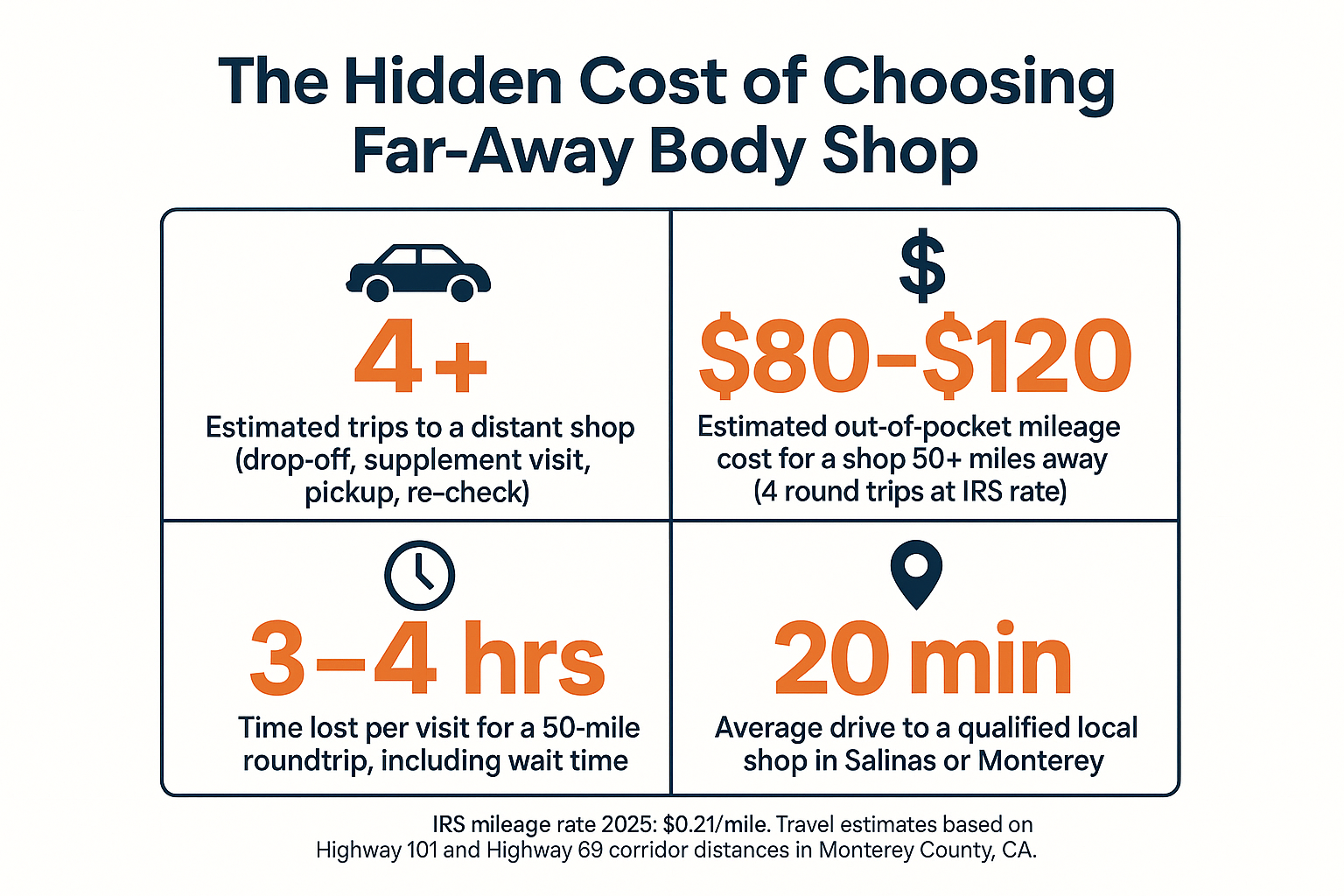
For a shop in San Jose or the Bay Area, that’s potentially four or more round trips over the repair timeline. At $0.21 per mile for IRS mileage, a 100-mile roundtrip costs you around $21 each visit — not counting your time or the cost of coordinating rides.
The real issue isn’t just mileage. It’s the unpredictability. Supplement estimates are extremely common on repairs involving more than minor cosmetic damage. What actually happens to your car between drop-off and pickup is a process with multiple stages, and being close to the shop makes that process much easier to manage.
For Salinas and Monterey County drivers, a qualified shop on Brunken Ave or nearby means you’re never more than 15-20 minutes from the facility during a repair. That matters more than most people realize until they’re in the middle of a job.
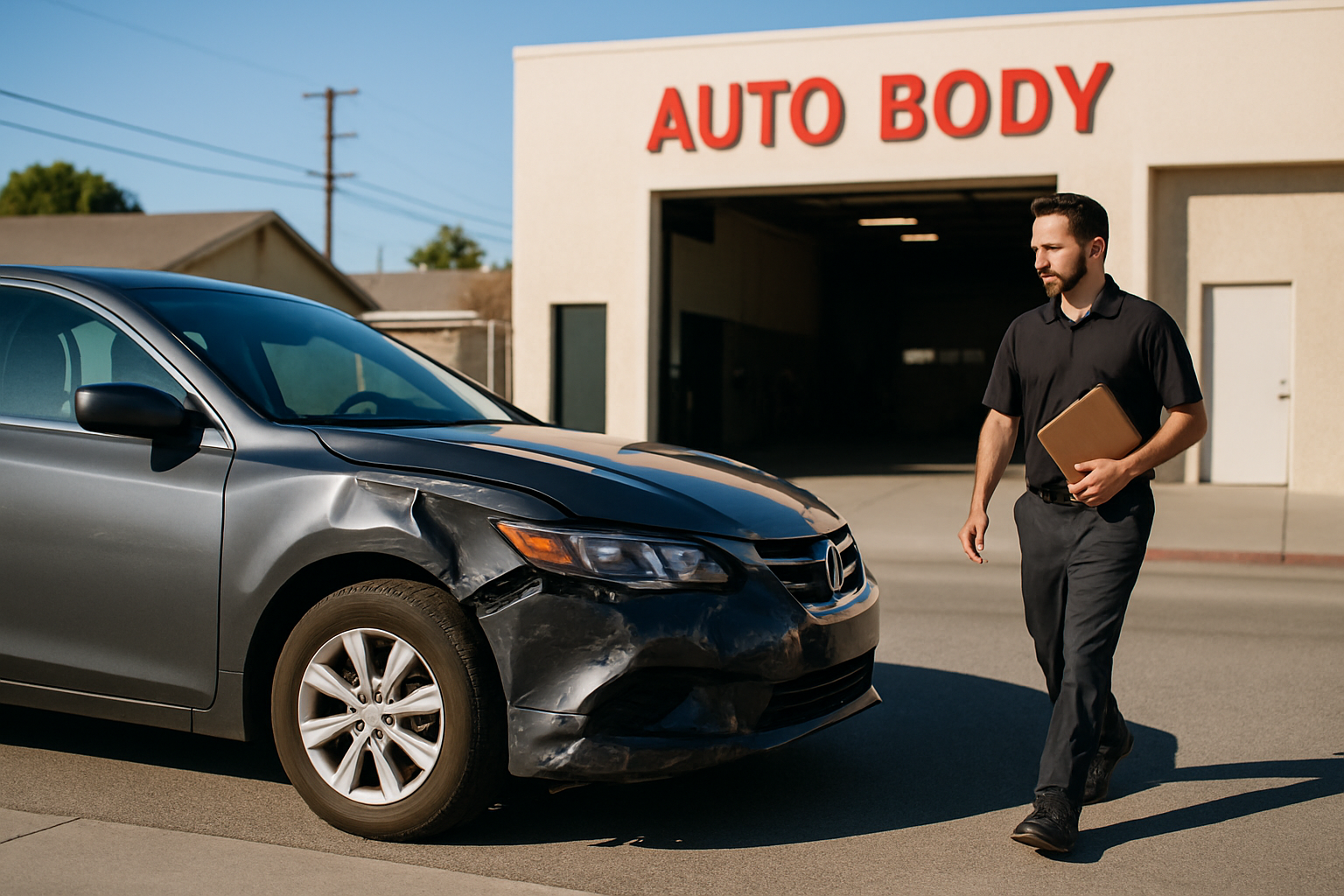
When Driving Farther Actually Makes Sense
There are real situations where going out of your immediate area is the right call. Knowing what those situations look like helps you make a clear-eyed decision instead of guessing.
Specialty vehicles or exotic repairs. If you drive a high-end European sedan, a classic, or a vehicle with unusual OEM requirements, you may need a shop with specific certifications or tooling that isn’t available everywhere in Monterey County. This is rare, but legitimate.
Insurer-directed shops that are out of area. Some insurance companies push drivers toward their preferred shops, which may not be local. Under California Insurance Code § 758.5, you have the legal right to choose your own repair facility — your insurer cannot require you to use a specific shop. If you weren’t aware of that, your insurance company does not actually get to choose where your car is repaired. Knowing that right often eliminates the need to travel at all.
A trusted referral to a specific certified shop. If someone you trust had exceptional results at a shop 40 miles away and the repair is significant — frame work, structural damage, a high-value vehicle — the extra distance might be worth it. But apply the same evaluation criteria you’d use locally: certifications, reviews, warranty on workmanship.
For most everyday collision repairs in Salinas, Monterey, Seaside, or Marina, none of these exceptions apply. A well-credentialed local shop will do the same quality work without the added coordination.
The Real Cost of Driving Far for Collision Repair
This breakdown shows how travel distance adds up across a typical collision repair — in both time and money.
What to Look for in a Local Shop Before You Commit
Distance alone isn’t the deciding factor — quality is. And quality has measurable indicators you can verify before you hand over your keys.
The two certifications that carry real weight in collision repair are AAA Approval and Gold Class I-CAR Certification. AAA Approved shops meet ongoing facility and workmanship standards that AAA audits directly. Gold Class I-CAR means the technicians have completed ongoing training on current vehicle structures, materials, and repair methods — including the newer high-strength steels and aluminum found in most vehicles made after 2015.
Beyond certifications, look for:
- A written warranty on bodywork — and ask whether it covers labor, materials, or both
- Shops that handle direct insurance billing so you’re not caught in the middle
- Consistent reviews that mention communication and timeline accuracy, not just finished appearance
- A physical address you can visit — not a mobile-only operation
For Monterey County drivers who’ve wondered why so many people from Monterey end up getting repairs done in Salinas, the answer usually comes down to exactly this: certified shops with long track records and the capacity to handle full collision work.
If you’re evaluating shops and aren’t sure what questions to ask, this guide on how to find a good auto body shop walks through what to look for and what to avoid.
Local vs. Out-of-Area Shop: Side-by-Side Comparison
Here’s a practical look at how local and distant shops compare across the factors that matter most to Monterey County drivers.
| Factor | Local Shop (Salinas/Monterey Area) | Out-of-Area Shop (Bay Area / San Jose) |
|---|---|---|
| Drive time per visit | 10–25 minutes | 45–90 minutes each way |
| Supplement visit logistics | Easy, low disruption | Requires full trip, often half a workday |
| Insurance coordination | Direct billing common locally | May vary; confirm before committing |
| Certifications available | AAA, I-CAR Gold Class in Salinas | Varies; verify independently |
| Workmanship warranty | Lifetime at some local shops | Varies by shop; ask in writing |
| Familiarity with CA § 758.5 | Local shops understand your rights | May not prioritize CA-specific guidance |
| Community accountability | 60+ year reputations possible locally | Harder to verify for out-of-area chains |
A Note on Driving a Damaged Vehicle Long Distances
If your car isn’t fully driveable after an accident, the distance question answers itself — you’re not going anywhere far until the vehicle is stabilized or towed.
But even a car that seems fine to drive may have structural or safety issues that aren’t obvious. A crumpled front end can compromise the bumper’s ability to absorb a second impact. A rear hit can shift alignment without the driver noticing. Is a cracked bumper still safe to drive with? — the answer is more nuanced than most people expect, and it depends on what’s behind the crack.
If there’s any question about whether your vehicle is safe to drive, have it assessed locally before you commit to any distance. Driving a compromised car 50 miles down Highway 101 to save money on repairs isn’t a trade worth making.
Frequently Asked Questions About Traveling for Collision Repair
My insurance company recommended a shop that’s 45 miles away. Do I have to use it?
No. Under California Insurance Code § 758.5, you have the legal right to choose your own repair facility. Your insurer can suggest a shop, but they cannot require you to use it as a condition of your claim. If they’re pressuring you, that’s a consumer protection issue worth pushing back on.
Is there a quality difference between local shops and larger shops in the Bay Area?
Not inherently. Quality comes from certifications, technician training, equipment, and process — not from city size or shop volume. A Gold Class I-CAR Certified shop in Salinas operates under the same training standards as a certified shop in San Jose. What you lose by going far is convenience, not quality — assuming the local shop is properly credentialed.
What if a shop farther away is significantly cheaper?
Be cautious. A significantly lower estimate usually means one of three things: they’re quoting fewer repair steps, using aftermarket parts instead of OEM, or they haven’t fully assessed the damage yet. A low estimate that grows substantially once teardown begins is common with shops that underquote to win jobs. Ask any shop — local or distant — to explain exactly what’s included in the estimate before you commit.
How do I know if a local Salinas shop can handle my specific vehicle?
Ask directly. Find out if they have I-CAR Gold Class certification (which covers training on modern vehicle materials and repair methods), whether they’ve worked on your make and model, and what their process is for OEM vs. aftermarket parts. If the shop is AAA Approved, that also means it’s passed an independent facility audit.
What happens if more damage is found after I’ve already dropped the car off far away?
This is the scenario that makes distance painful. A supplement estimate — additional damage found during teardown — is common on anything beyond minor cosmetic repairs. If the shop is far away, you’ll need to make another trip to review and approve the additional work, or manage everything by phone, which is harder. A local shop makes that conversation much simpler.
Need a Repair Estimate Without the Runaround?
Searson Collision Center has been handling collision repair in Salinas since 1963 — AAA Approved, Gold Class I-CAR Certified, and within easy reach of drivers throughout Monterey County. If you’ve got damage and want a straight answer on what it’ll take to fix it, call (831) 422-2460 or visit searsoncollisioncenter.com to schedule your free estimate.