AI Answer: You can tell if your car frame is bent by looking for specific signs after a collision. Key indicators include the car pulling to one side while driving, uneven gaps between body panels (like doors and fenders), doors or a trunk that don’t close properly, and unusual or rapid tire wear on the inside or outside edges. Hearing strange creaking or clunking noises, especially when turning or going over bumps, is another common symptom. While these visual and sensory checks are helpful, the only way to be certain is to have the vehicle inspected by a professional collision repair shop using a computerized laser measuring system.
After a collision in the Salinas area, your first thoughts might be about visible dents and scrapes. However, the most serious damage is often hidden, and learning how to tell if your car frame is bent is critical for your safety.
A bent frame compromises your car's structural integrity, making it unsafe to drive. Even minor accidents can cause frame damage. In fact, a significant number of all collisions result in some level of structural misalignment that isn't immediately obvious (I-CAR, 2023).
Why a Straight Frame is Non-Negotiable for Safety
Your car's frame is its skeleton. It’s the core structure that everything else—the engine, suspension, and body panels—bolts onto. More importantly, it was engineered to keep you and your passengers safe in an accident.
A straight frame provides structural rigidity, keeping the car stable and predictable during everyday driving. When that frame is bent, the car’s ability to handle corners or even keep tires planted on the pavement is seriously compromised.
Understanding Your Vehicle's Structure
Most modern cars have a unibody design, where the frame and body are a single, welded structure. This integration allows engineers to build sophisticated safety features directly into the car's foundation.
On the other hand, most trucks and some larger SUVs use a traditional body-on-frame construction. Here, the vehicle's body is mounted onto a separate, heavy steel frame. Though they absorb impacts differently, the principle is the same: the frame must be perfectly straight to do its job.
Crumple Zones and Crash Protection
Modern car safety hinges on a concept called crumple zones. These are specific areas at the front and back of the vehicle designed to collapse in a controlled way during a crash. They act like shock absorbers, soaking up impact energy and directing it away from the people inside.
A bent or previously damaged frame cannot manage crash energy as intended. Its ability to protect you in a future accident is significantly reduced because the crumple zones will not function correctly. This is why knowing if your frame is bent is so important; a compromised frame means your car’s most critical safety system is already broken.
Visual Clues: How to Tell if Your Car Frame is Bent by Looking
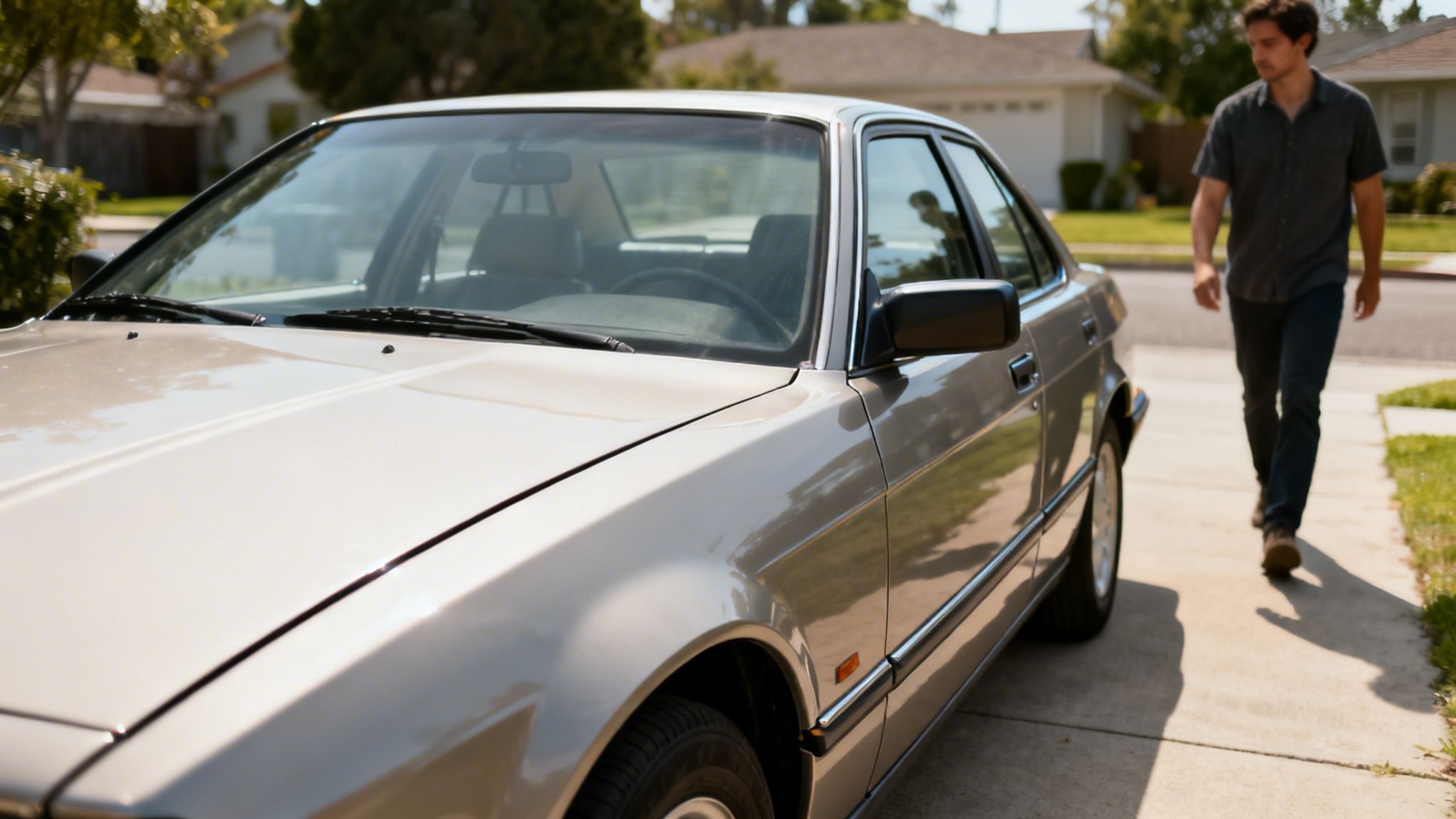
You can find many clues just by taking a few minutes to look your car over carefully. A simple walk-around can reveal some of the most obvious signs of a bent frame. You just need to know what to look for.
First, park your car on flat, level ground, as a slope can trick your eyes. Step back 10-15 feet and observe its stance. Does the vehicle sit squarely, or does one side seem to sag or sit higher than the other?
Check Your Body Gaps and Seams
The most common visual giveaway of frame damage is uneven gaps between the body panels. When a car leaves the factory, the spacing between the hood, fenders, doors, and trunk is incredibly consistent. An impact can shift the entire structure, causing those perfect seams to go out of whack.
A quick way to check this is to use your fingers as a gauge. Slide them along the gap between a door and fender; if the space is wide at the top but tight at the bottom, that’s a huge red flag.
Open and Close Doors, Hood, and Trunk
Next, test every moving part. Your doors, hood, and trunk are mounted directly to the car’s chassis. If the frame is bent, these components will almost always have trouble operating correctly.
- Doors That Fight You: Does a door that used to close effortlessly now require a hard slam? Or maybe it sticks, grinds, or won't latch without being lifted? That's a classic sign the door frame is twisted.
- Hood and Trunk Misalignment: Pop the hood and gently lower it. Does it sit flush and even with the fenders, or is it crooked? Do the same with your trunk lid. Any misalignment means the frame's mounting points have shifted.
A visual inspection is a great first step, but it won't catch everything. Hidden damage can exist even if the car looks fine, which is why a professional check is so important after any accident.
Driving Sensations: What a Bent Frame Feels Like on the Road

Sometimes, the biggest clues are things you feel, not see. After an accident, you might notice your car just "drives funny." Trust that feeling; it's often the first and most reliable sign that the vehicle’s core structure is compromised.
The most common complaint we hear from drivers in Salinas and Monterey County is a car that stubbornly pulls to one side. You might feel like you're constantly fighting the wheel just to keep the car tracking straight. It's easy to mistake this for a simple alignment issue, but if you get an alignment and the problem persists, it’s a massive red flag for frame damage.
The Constant Pull and Other Steering Issues
When a car's frame is knocked out of kilter, it throws the entire suspension and steering geometry into disarray. This forces your wheels to fight against each other, creating that persistent pulling sensation. According to NHTSA data, rear-end collisions, which can easily cause frame issues, account for approximately 29% of all crashes (NHTSA, 2024).
It’s not just about pulling, though. Keep an eye out for other steering quirks:
- Off-Center Steering Wheel: When you're driving straight, is your steering wheel level or tilted? A bent frame can twist the steering linkage, making the wheel sit at an angle even when the tires point forward.
- Poor Steering Response: The car might feel "loose" or less responsive than before. It might not turn as sharply, or you may feel a worrying instability when taking corners.
Unusual Noises and Vibrations
Strange new sounds are another huge piece of the puzzle. A bent frame puts unnatural stress on parts like suspension components and bushings, forcing them to groan, creak, or clunk.
Listen for any noises that weren't there before the accident, especially when turning at low speeds or going over bumps. A vibration you can feel through the steering wheel or floor, particularly at highway speeds, is another common symptom. These are direct communications from your vehicle that its fundamental structure is compromised and needs professional attention.
Clues from Your Tires and Suspension
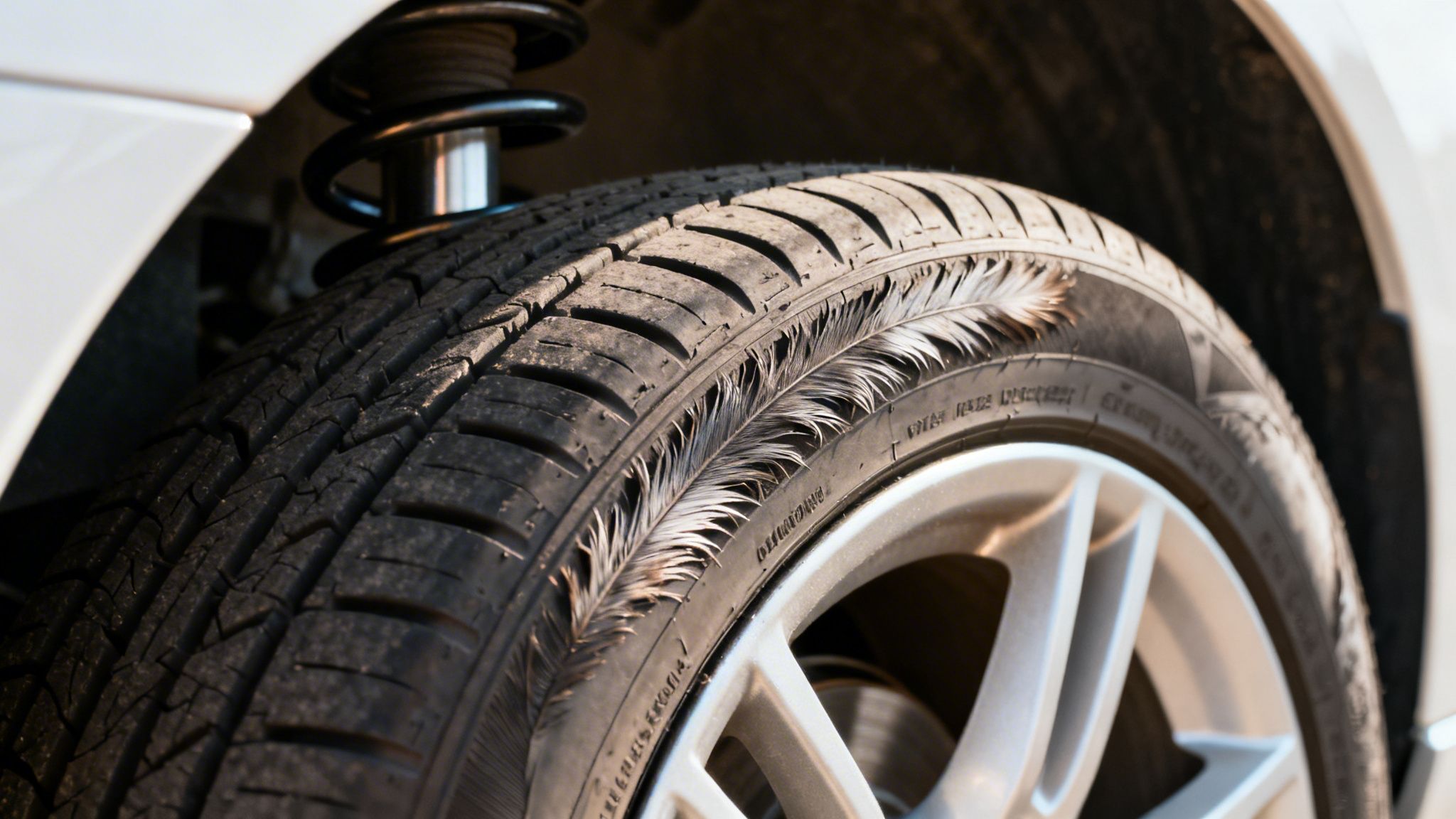
While you'll probably notice strange noises or handling problems right away, your tires and suspension tell a slower story. After an impact, your tires become one of the most honest storytellers about the structural health of your vehicle.
When a car's frame is bent, the wheels can no longer track in a perfectly straight line. This subtle misalignment forces the tires to drag or scrub sideways as you drive, creating distinct and uneven wear patterns.
Reading the Story of Uneven Tire Wear
The most common sign is aggressive wear on just one edge of a tire. You might see the inside shoulder of a tire worn bald while the outside edge looks new. This is a classic symptom of a bent frame messing with the suspension geometry.
This creates a few tell-tale patterns over time:
- Feathering: Run your hand across the tread. If one side of each tread block feels sharp and the other is smooth, that's feathering, a dead giveaway that the tire is scrubbing sideways.
- Cupping or Scalloping: This looks like diagonal or scooped-out patches across the tire's surface. Cupping often points to a combination of alignment and suspension trouble, which usually traces back to frame damage.
Uneven tire wear is a delayed but incredibly reliable symptom. In cars with unrepaired frame damage, abnormal tire wear shows up in the vast majority of cases within just a few thousand miles of driving. Proper auto alignment and suspension services in Salinas are essential, but they are only a temporary fix if the underlying structure is damaged.
Why a Professional Inspection is the Only Sure Answer
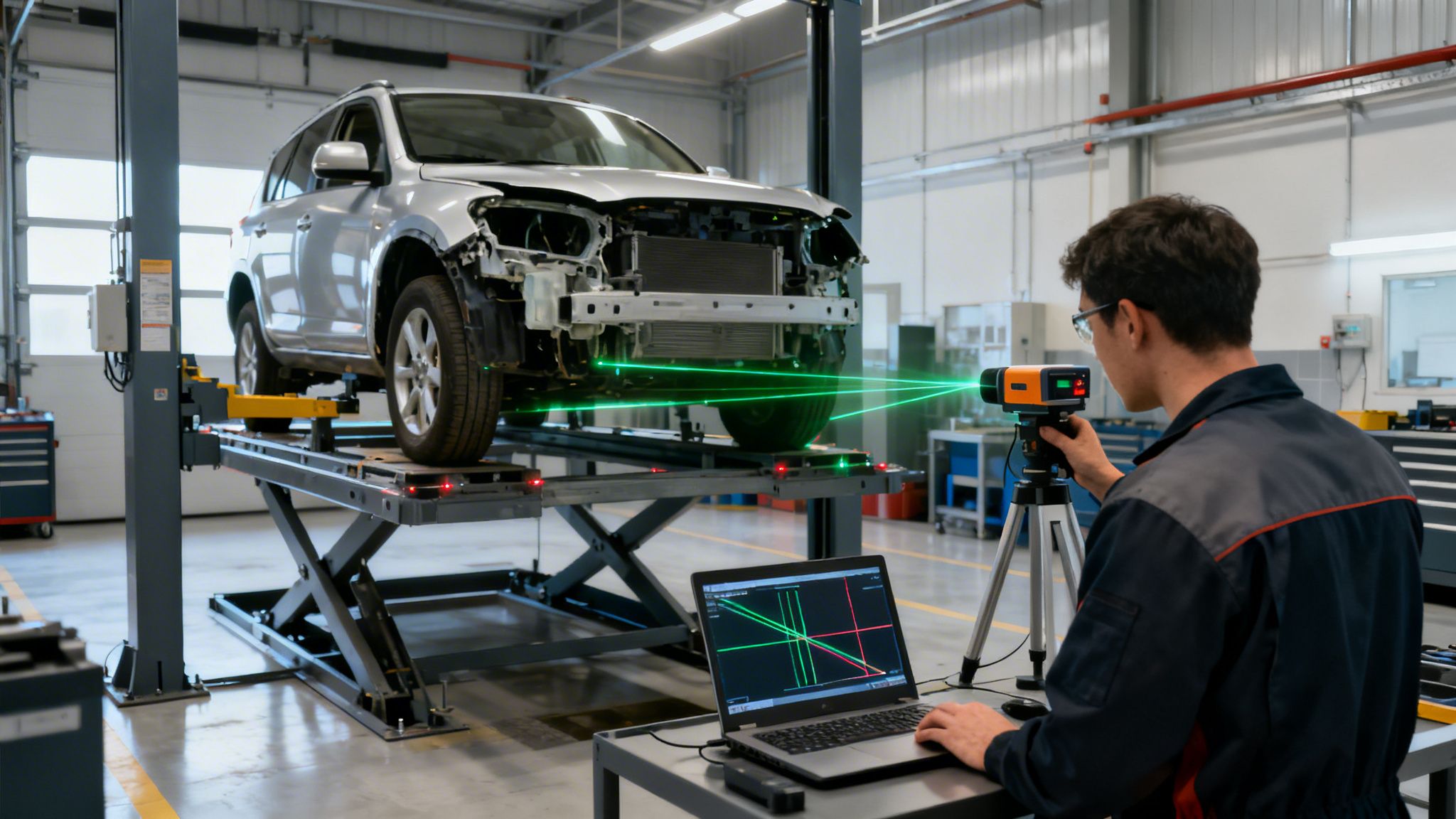
You’ve done your homework, walked around the car, and noticed something feels off when you drive. Those clues are invaluable for pointing you in the right direction. But what they can't tell you is how deep the problem goes.
That's where a professional inspection comes in. This isn’t about upselling you on services you don’t need; it’s about safety. When it comes to your car's structural integrity, there's absolutely no room for guesswork.
Beyond the Naked Eye
An experienced collision tech can spot things most people would miss, but even the best eyes have limits. To get the full story, we rely on specialized technology. At our shop, we use computerized laser measuring systems that provide irrefutable data by comparing your car’s chassis to its original factory specifications.
Think of it as a high-definition digital blueprint of your car’s frame. This map instantly reveals every deviation, no matter how small, and gives a definitive, data-backed answer. An I-CAR study revealed that nearly 50% of collisions cause some level of structural misalignment, with much of it being impossible to detect visually (I-CAR, 2023).
Why This Precision Matters
A professional diagnosis is the only way to create a reliable roadmap for repair. Without precise measurements, a technician is essentially working blind. It’s also crucial for your insurance claim and your peace of mind.
Ultimately, the goal is to ensure the car is structurally sound and safe. The detailed report from a laser measurement system provides proof of damage for your insurance claim and serves as a certificate of a proper, accurate repair. You can learn more about how we handle this vital work in our guide to auto frame and structural repair in Salinas.
Frequently Asked Questions About Bent Car Frames
Q: Can a bent car frame actually be fixed?
A: Absolutely. In most cases, a bent frame can be repaired safely and accurately. A certified shop uses hydraulic frame racks and computerized measuring systems to pull the structure back to its precise factory specifications, often within a millimeter of the original blueprint.
Q: Is it safe to drive a car with a bent frame?
A: No, driving with a bent frame is incredibly risky. It compromises the whole structure, affecting steering, handling, and how the car absorbs impact in a future accident. If you suspect frame damage, the safest move is to stop driving and have it inspected by a professional.
Q: How much does frame repair cost?
A: The cost varies widely based on the severity of the damage and the vehicle type. A minor tweak might be a few hundred dollars, while complex structural realignment can be several thousand. According to the California Bureau of Automotive Repair, the average auto body repair invoice was $3,510 in 2023, and structural repairs can be a large part of that (BAR, 2024).
Q: Will my insurance cover frame repair?
A: If the damage occurred during a covered event like an accident, your auto insurance policy should cover the frame repair. We work directly with all major insurance carriers to ensure all necessary structural work is documented, approved, and paid for according to your policy. Remember, you have the right to choose your repair shop under California law (California Insurance Code § 758.5).
Q: How do you prove a frame was repaired correctly?
A: A proper repair is a return to the manufacturer's original dimensions, not just "close enough." We provide a computerized printout showing the frame's measurements before and after the repair. This report is your verifiable documentation that the job was done right and your car is safe.
Q: What is the difference between unibody and body-on-frame?
A: A unibody vehicle, like most modern cars, has its frame and body integrated into a single structure. A body-on-frame vehicle, like most trucks, has a separate body bolted onto a heavy, rigid frame. Both types require precise alignment for safety, but the repair process can differ.
Q: If my car looks fine after an accident, can the frame still be bent?
A: Yes, absolutely. Modern bumpers and body panels can absorb a low-speed impact and pop back into shape, but the energy from the crash can still transfer to the underlying frame and bend it. This hidden damage is why a professional inspection is crucial even after a seemingly minor collision.
If you're in the Monterey Bay Area and are trying to figure out how to tell if your car frame is bent, don't guess with your safety. The team at Searson Collision Center is here to provide a free, expert estimate and the clear answers you need.
Give us a call at (831) 422-2460 or stop by our shop at 488 Brunken Ave, Salinas, CA 93901. We're here Monday through Friday, 7:00 AM to 5:00 PM.
Sources
- California Bureau of Automotive Repair (BAR). "Consumer Assistance Program Statistics." 2024.
- I-CAR. "Collision Repair Industry Trends." 2023.
- National Highway Traffic Safety Administration (NHTSA). "Traffic Safety Facts: Crash Stats." 2024.
- State of California. "California Insurance Code § 758.5." Current. https://leginfo.legislature.ca.gov/faces/codes_displaySection.xhtml?lawCode=INS§ionNum=758.5.