Direct Answer: Look for I-CAR Gold Class certification, a written workmanship guarantee, and a shop that handles insurance communication directly — those three things separate trustworthy shops from the rest.
Most people don’t have a go-to body shop. You go years without needing one, and then one day you’re standing in a parking lot on North Main Street looking at a crumpled quarter panel — and suddenly you need to pick a shop you’ve never stepped inside.
That’s a stressful spot to make a decision. The wrong choice can mean months of back-and-forth, paint that doesn’t match, or repairs that don’t hold. In Monterey County, where there’s no shortage of shops ranging from certified facilities to one-bay operations, knowing what to actually look for makes a real difference.
This article focuses on the two or three things that matter most when evaluating a shop cold — and what those things actually tell you about the repair you’re about to pay for.
Why Certifications Tell You More Than Reviews
Reviews are helpful, but they’re easy to game and hard to verify. Certifications aren’t. When a shop holds real industry credentials, those have to be earned and maintained — and they tell you something concrete about the quality of work being done.
The one certification worth knowing is I-CAR Gold Class. I-CAR is the industry training organization that sets repair standards for collision work. Gold Class is their highest shop-level designation, and fewer than 20% of collision shops in the U.S. earn it. It means the technicians working on your car have passed ongoing training in current repair methods — including work on newer vehicles with aluminum panels, advanced driver-assist sensors, and high-strength steel structures that can’t be repaired the same way a 2005 Civic was.
The other credential that carries real weight locally is AAA Approved status. AAA audits shops before approving them and removes shops that stop meeting their standards. It’s not a vanity badge — it requires consistent performance.
Beyond credentials, ask one specific question: Does the shop offer a written lifetime guarantee on their bodywork? A shop confident in their work puts it in writing. One that hedges or gives you a vague verbal answer is telling you something.
For a broader look at how to find a good auto body shop, the factors go deeper than star ratings — credentials and accountability structures are what separate a professional operation from a budget alternative.
What the Estimate Process Actually Tells You
The estimate isn’t just a price — it’s your first real look at how the shop operates. A shop that does thorough estimates works differently than one that eyeballs your car for five minutes and hands you a number.
Here’s what a professional estimate process looks like:
- The shop documents every panel involved, not just the obvious damage
- They note whether sensors, cameras, or structural components may be affected — a rear bumper hit, for example, can compromise parking sensors or a backup camera (what happens to bumper sensors when they get hit is something a lot of drivers don’t think about until it comes up)
- They explain the difference between visible damage and hidden damage that won’t surface until teardown
- They walk you through what the insurance process will look like, including the possibility of a supplement estimate if more damage appears once the car is disassembled
A shop that skips any of those steps isn’t doing you a favor with a fast turnaround — they’re setting up problems for later.
Also pay attention to communication style during the estimate. Are they explaining things in plain language, or rattling off part numbers? Do they answer questions without making you feel like you’re wasting their time? That tone usually holds throughout the repair.
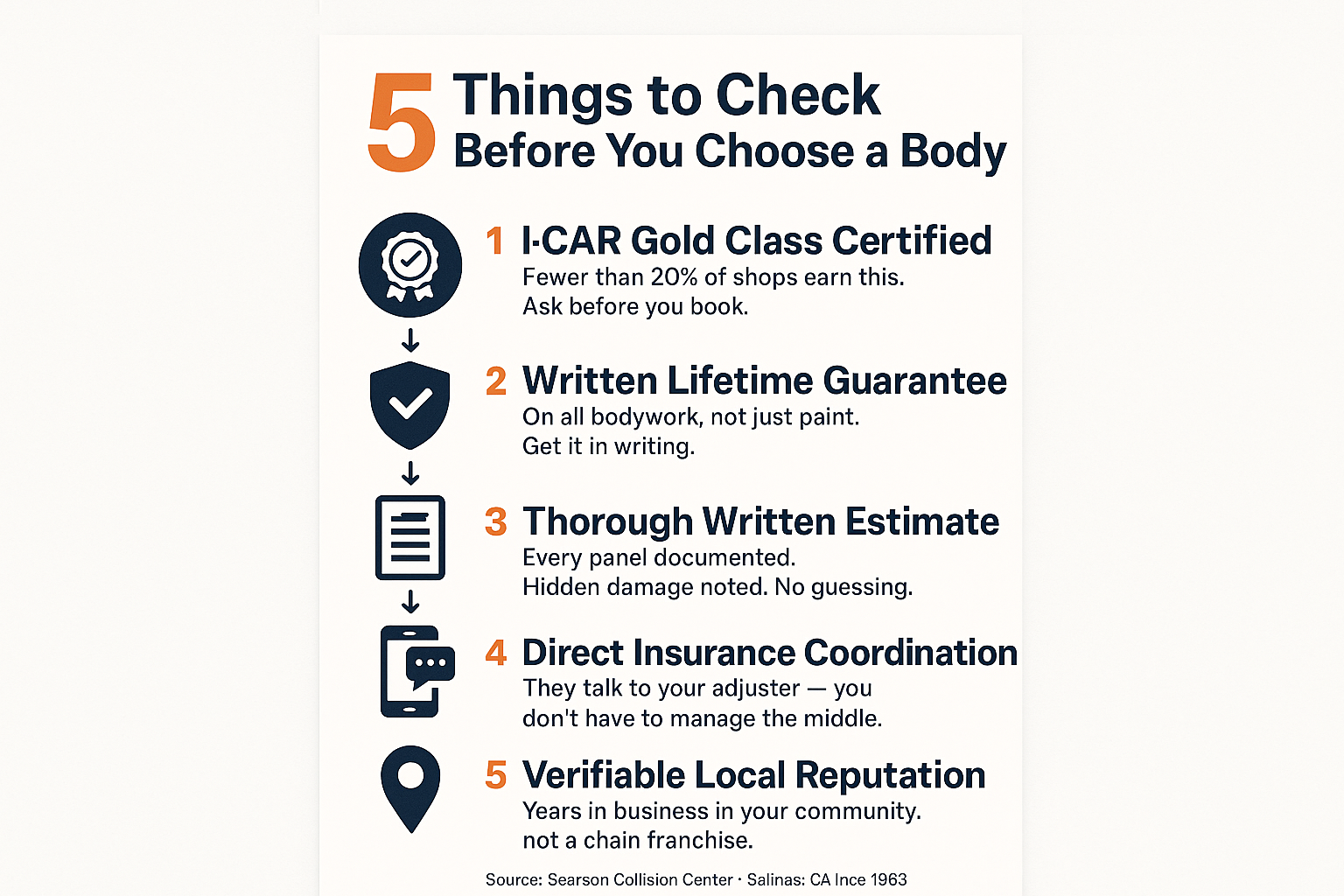
5 Things to Check Before You Choose a Body Shop
Use this checklist when evaluating any shop you haven’t used before — especially when you’re dealing with an insurance claim and don’t have time for a mistake.
Your Insurance Company Does Not Get to Choose Your Shop
This is one of the most misunderstood parts of the whole process. When you file a claim, your insurer will often recommend a shop from their preferred network — sometimes called a Direct Repair Program (DRP). That recommendation can feel like a requirement. It isn’t.
Under California Insurance Code § 758.5, you have the legal right to choose any licensed shop you want for your repair. Your insurer cannot force you to use a specific facility. They can suggest one. They cannot require one.
Why does this matter when you’re choosing a new shop? Because if your insurer steers you toward a shop you’ve never heard of and you’re not sure about, you don’t have to go. You can do your own research, check credentials, and choose the shop that gives you the most confidence — regardless of who your insurance company prefers.
For more on how this works in practice, does your insurance company actually get to choose where your car is repaired? breaks down your rights in plain language.
One practical note: if you choose a shop outside the insurer’s network, there can sometimes be minor friction around supplement approvals or part selection. A shop with experience handling insurance claims directly — one that talks to adjusters regularly — will navigate that friction for you without turning it into your problem.
Certified vs. Non-Certified Shop: What the Difference Usually Looks Like
This isn’t about price alone — it’s about what you’re actually getting for that price. Here’s how the two typically compare on the factors that matter most.
| Factor | I-CAR Gold Class / AAA Approved Shop | Non-Certified Shop |
|---|---|---|
| Technician Training | Current, ongoing — required to maintain certification | Varies; no external requirement |
| Workmanship Guarantee | Usually written and lifetime | Often verbal only, or limited |
| Insurance Coordination | Handles supplements and adjuster contact directly | Often leaves this to the customer |
| OEM Repair Standards | Required to follow manufacturer specs on newer vehicles | May or may not follow them |
| Accountability | Audited by third party (I-CAR, AAA) | Self-reported only |
| Typical Repair Cost | Comparable to non-certified for most jobs | May appear lower upfront; hidden costs possible |
One Question That Filters Out Most Bad Shops Immediately
If you only ask one question when evaluating a shop you’ve never used, make it this: “How do you handle supplement estimates?”
A supplement estimate is what happens when the shop tears into a damaged vehicle and finds damage the original estimate didn’t capture — which is extremely common in any collision repair job. Hidden frame damage, bent brackets, damaged wiring, corroded mounting points underneath a panel that looked fine from the outside.
A shop that handles this well will explain the process upfront: they document the additional damage, photograph everything, write up the supplement, and send it to your insurer directly. You get notified, and the repair timeline adjusts. That’s normal and expected.
A shop that gives you a blank look or says something like “we’ll figure it out” when you ask about supplements is one that either doesn’t deal with insurance often, or one that’s used to letting those conversations become the customer’s problem.
For drivers who’ve never been through a full collision repair before, a driver’s step-by-step guide to car accident repair explains what the full process looks like from first call to pickup — including where supplements fit in and what to expect at each stage.
The Salinas area sees a steady stream of Highway 101 and Highway 68 accidents, especially in winter when tule fog makes visibility dangerous on the valley floor. Drivers coming in post-accident are often stressed and unfamiliar with the process. A shop that can answer that supplements question clearly, without hesitation, has obviously walked people through it before.
Frequently Asked Questions About Choosing a Body Shop
How do I know if a shop’s certifications are actually current?
You can verify I-CAR Gold Class status directly on the I-CAR website at i-car.com — search by shop name or zip code and it’ll show you current certification status. AAA Approved shops are listed on the AAA website as well. Don’t just take a wall plaque at face value; take 60 seconds to check.
Is a family-owned local shop better than a chain?
Not automatically — but a local shop with 60+ years in the same community has a track record you can actually evaluate. National chains have high technician turnover and standardized processes that don’t always account for the specifics of your vehicle. A local shop’s reputation depends entirely on how they treat the people who live nearby. That creates a different kind of accountability.
Can I get an estimate from multiple shops before deciding?
Yes, and you should feel free to. Most reputable shops offer free estimates with no obligation. Getting two or three estimates gives you a basis for comparison — not just on price, but on how thoroughly each shop documented the damage and how clearly they communicated what the repair involves.
What if the shop my insurer recommends isn’t certified?
You’re not required to use it. Under California law, you choose the shop. If the insurer’s recommended shop doesn’t hold I-CAR Gold Class or another verifiable certification, that’s a legitimate reason to go elsewhere. Your insurer must work with whatever licensed shop you choose.
Does it matter if the shop is far from where I live?
Distance matters more than people think — especially for pickup logistics after the repair is done. But if the nearest certified shop with a strong local reputation is 20-30 minutes away, that’s usually worth the drive over choosing a closer shop with no verifiable credentials. How far should you travel for collision repair covers this tradeoff in more detail.
What does ‘restored to pre-accident condition’ actually mean?
It means the vehicle should look, function, and structurally perform the way it did before the accident — using repair methods that meet the original manufacturer’s specifications. That includes paint color match, panel alignment, sensor calibration, and structural integrity. It doesn’t mean every vehicle comes out of every repair looking brand new — paint on older vehicles with existing fade requires specific blending work, and how shops match paint on a car that’s already faded explains why that part of the process is more involved than most people expect.
Ready to Talk Through What Your Car Actually Needs?
Searson Collision Center has been repairing vehicles in Salinas since 1963 — and the team is used to walking first-time customers through exactly what to expect, from the first estimate to the final inspection. If you’re dealing with collision damage, a dent, or paint work anywhere in Monterey County, you can schedule a free estimate by calling (831) 422-2460 or visiting searsoncollisioncenter.com.