You pick up your car, step back, and something looks off. The repair may be solid, but the color on one panel seems a little brighter, darker, cleaner, or flatter than the rest.
That reaction is reasonable. When people ask why doesn’t the repaired panel on my car match the rest of the paint?, the answer is usually not one simple mistake. It is a mix of chemistry, age, lighting, surface material, and repair method.
Why Your Car’s Paint Code Is Only a Starting Point
The paint code on your door jamb is useful, but it is not magic. It tells a technician what the vehicle was supposed to be when it was new, not exactly what your car looks like today.

A paint code is a formula, not a visual guarantee
A customer will often say, “If you have the code, why can’t you mix it and spray it?” Fair question. The problem is that the code is a starting recipe for fresh paint on a controlled surface.
Most vehicles being repaired are not fresh anymore. The average age of vehicles on U.S. roads has climbed to 12.8 years, and for 80% of these cars, any collision repair involves the significant challenge of matching new paint to an aged, weathered finish (Kelley Blue Book, 2023, https://www.eastwood.com/garage/why-doesnt-my-paint-match/).
That is why a good refinish process starts with the code and then moves beyond it. If you want context on the broader repair process, this overview of https://searsoncollisioncenter.com/auto-collision-repair-in-salinas/ shows how paint work fits into complete collision repair.
Factory variation exists before a car ever gets damaged
Even before weather gets involved, automotive paint is not identical from one application to the next. A color can be “correct” to manufacturer standards and still look slightly different next to another panel.
That matters because customers often assume mismatch means someone mixed the wrong color. Sometimes the formula is technically correct, but the surrounding paint has its own history, its own exposure, and sometimes its own previous repair.
Key takeaway: A paint code gets the technician to the right family of color. It does not eliminate the need for color reading, test panels, tinting decisions, and blending.
What a skilled painter does
In a quality repair, the technician does more than enter the code and press print. The job includes reading the vehicle’s present color, looking at the finish in different light, and adjusting for what the eye will see on the car.
That is especially true with metallics, pearls, silvers, whites, and light colors. Those finishes can look different depending on viewing angle, film build, and how the particles lay down in the paint.
A veteran painter learns to think in two ways at once. One is technical. The formula, the reducer choice, the booth conditions. The other is visual. Does this panel disappear next to the door in shade, sunlight, and late afternoon light?
How Sun and Time Change Your Car’s Original Color
Even if your car has never been repaired before, the paint it wears today is not the same paint it wore when it left the factory. Sun, air, moisture, road grime, and normal aging all slowly push the color away from that original formula.
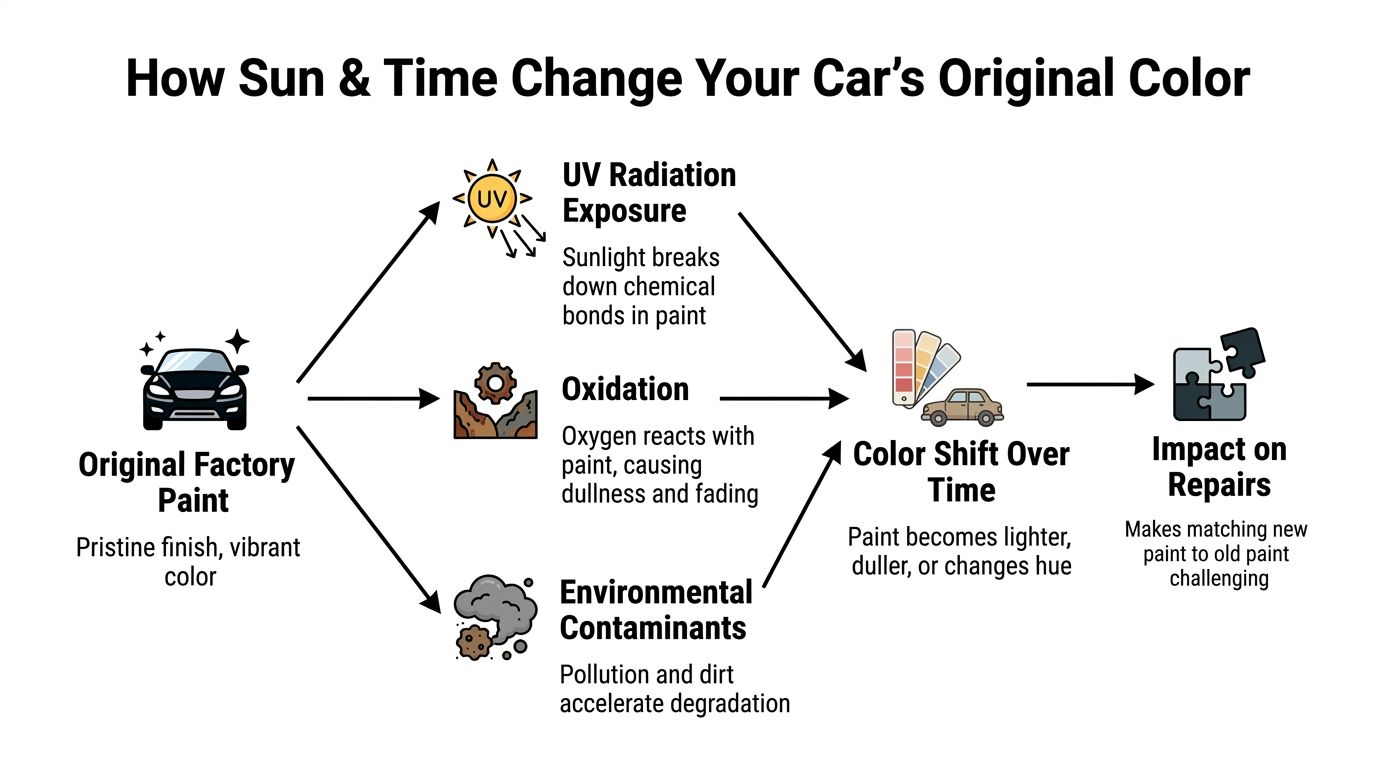
UV changes color even when the code is right
In the Salinas and Monterey Bay Area, vehicles see a mix of coastal conditions and inland sun. That matters because ultraviolet radiation can shift a car’s paint color by 5-15% in chroma and hue after just 3-5 years in sunny climates (I-CAR Training Materials, 2024, https://www.paintedoemparts.com/post/why-color-accuracy-matters-when-replacing-car-body-panels-the-ultimate-guide).
Customers usually notice this when the repaired panel looks “too new.” That is often exactly what happened. The new paint is cleaner and truer to formula than the rest of the car.
Why spectrophotometers help
A modern shop does not rely on the code alone. It uses a spectrophotometer to read the actual color on the vehicle now.
According to the same I-CAR material, a professional spectrophotometer can measure variance to 0.1 Delta E, and a value greater than 2.0 is easily perceptible to the human eye (I-CAR Training Materials, 2024, https://www.paintedoemparts.com/post/why-color-accuracy-m_atters-when-replacing-car-body-panels-the-ultimate-guide). In plain terms, that means color difference is measurable, and people really do see it.
How paint ages in practice
Paint does not fade evenly. Horizontal panels often age differently than vertical ones. One side of a car may have seen more sun. A hood may have drifted differently than a door.
Then add prior polishing, old repairs, and years of washing products. By the time a car is several years old, the finish can no longer be treated like a brand-new sample card.
Practical tip: If you are dropping off a car for paint work, bring it in clean and tell the shop about any prior body or paint repair. Hidden history makes color matching harder.
The Challenge of Painting Different Materials
A repaired panel can also look off because not all vehicle parts are made of the same thing. Paint behaves differently on steel, aluminum, and plastic, even when the color formula is the same.

Why bumpers are notorious
Bumpers are where many complaints start. They are usually plastic, and that changes both how paint lays down and how it cures.
Paint color can vary by up to 20-30% in perceived shade when applied to plastic versus metal due to differing surface textures and heat tolerances during the curing process. Mismatch complaints involving bumpers are extremely common, with the plastic-metal interface being a factor in an estimated 85% of such cases (Collision Repair Industry Discussions, 2024, https://www.pistonheads.com/gassing/topic.asp?h=0&f=136&t=1749214).
That is why even factory vehicles sometimes show a slight difference between the bumper and the adjacent quarter panel or fender. It is not always poor workmanship. Sometimes, the inherent nature of different substrates contributes to this.
Material changes the process
Plastic parts need different prep, adhesion steps, and refinishing judgment than metal panels. The painter has to account for flexibility, texture, and how the part handles heat.
A scuffed bumper repair may look simple from the outside, but the refinishing side can be tricky. If you are dealing with cosmetic damage rather than full collision work, https://searsoncollisioncenter.com/auto-dent-scratch-removal-in-salinas/ gives a useful look at the kind of repairs that often lead into this paint-matching issue.
What works and what does not
What does not work is assuming one formula sprayed on one part will automatically look the same on the next part. What works is adjusting process for the material and planning the repair around what the eye will notice at the panel break.
Shop-floor reality: A bumper-to-fender match is one of the hardest visual transitions on a car. It deserves more care, not less.
The Professional Solution Blending for an Invisible Repair
If the goal is for the repair to disappear, blending is often the right answer. That means extending color into the adjacent panel so the eye never hits a hard stop between old paint and new paint.
Blending is standard care, not a shortcut
Some customers hear “blend” and think the shop is covering up a bad match. In reality, blending is how good shops handle the fact that adjacent panels are aged, weathered, and visually connected.
A clear data point on that is straightforward. Customer satisfaction with paint repairs jumps dramatically with proper technique; blending paint across three adjacent panels can yield 92% satisfaction rates, compared to 45% for unblended, single-panel spot repairs (PPG Industry Study, 2026, https://www.leonsautobody.com/news/this-is-why-your-bumper-colour-doesn’t-match-the-rest-of-the-car-paint-after-auto-body-repairs/).
If you want to understand the refinishing side of that process in practical terms, https://searsoncollisioncenter.com/auto-paint-refinishing-in-salinas/ is a good reference point.
What blending means
Blending usually involves the repaired panel and one or more neighboring panels. The new color is tapered out so there is no obvious paint edge where the eye expects continuity.
This matters most on:
- Metallic finishes where flake orientation changes the look
- Pearl and tri-coat colors where depth shifts with angle
- Lighter colors that show contrast quickly
- Older vehicles where fresh paint can look too crisp
How to inspect the result properly
Do not judge a paint match under delivery lights or in bright sun. Look at it in more than one condition.
Use this quick check:
- Step back first: Stand several feet away and look at the vehicle as a whole.
- Move around it: Metallics can change as your angle changes.
- Check sun and shade: A color can pass in one and fail in the other.
- Look across body lines: Panel breaks can hide or exaggerate differences.
- Compare gloss and texture: Sometimes the color is close, but the finish is what looks wrong.
What does not work well
Panel-only spot repairs on visible exterior areas often disappoint when the surrounding paint has any age on it. Fast insurance-driven decisions can also lead to repairs that are technically completed but visually obvious.
A careful shop plans for what the customer will notice walking up to the car in a parking lot, not just what passes under booth lights.
How to Diagnose a Paint Mismatch on Your Vehicle
If you think the color is off, inspect it before deciding whether it is a true mismatch or a lighting trick. People often catch a problem correctly, but they sometimes check it in one condition.
Start outside. Look at the repaired area in direct sunlight, then in open shade, then later under indoor lighting. A mismatch usually stays noticeable in more than one setting.
Watch for three separate issues:
- Base color difference means the panel looks plainly lighter, darker, warmer, or cooler.
- Metallic flop difference means the color shifts oddly as you move around the car.
- Gloss or texture difference means the shade may be close, but the surface reflects light differently.
A good comparison method is to look across the panel gap, not just at the repaired panel by itself. Your eye is most sensitive where one panel meets another.
If you are talking to a shop, ask direct questions instead of general ones. Ask whether they matched to the car’s current finish or to the code. Ask whether prior repainting on nearby panels may be affecting what you see. Ask whether blending was performed or recommended.
Simple rule: If the panel jumps out at you from normal standing distance, the concern is worth bringing back to the shop.
Not every slight variation means the repair failed. Bumpers, metallics, and certain light colors are less forgiving. But an obvious edge, halo, or color jump deserves a second look.
Questions to Ask Your Body Shop and Insurance Provider
Most trouble starts before the paint is sprayed. It starts when the estimate is written too narrowly or the process is not explained clearly.
Questions for the body shop
Ask these before repairs begin:
- Will you use a spectrophotometer? That tells you the shop is matching the vehicle’s present color, not just the factory code.
- Are you planning to blend adjacent panels? If the answer is no, ask why that is appropriate for your specific color and vehicle age.
- Do you see signs of prior paintwork? Previous repairs can change color match strategy.
- What should I expect on plastic parts like bumpers? Honest answers are most important here.
If you need help understanding the claim side while asking those questions, https://searsoncollisioncenter.com/auto-insurance-assistance-in-salinas/ explains how repair and insurance communication often overlap.
Questions for your insurance provider
Insurance conversations should be as direct.
Ask:
- Does this estimate include blending if the shop determines it is needed for a proper visual match?
- If the shop supplements for refinish operations, how is that handled?
- Am I free to choose my repair shop?
In California, you generally have the right to choose your own repair facility under California Insurance Code § 758.5. In plain language, an insurer cannot require you to use a particular shop. They can suggest one, but the choice is yours.
The practical trade-off
The cheapest-looking estimate on paper is not always the repair that looks best when done. Paint matching lives in the details, and details take labor, materials, and time.
That does not mean every repair needs every extra step. It does mean you should understand what is being included and what is being left out.
Frequently Asked Questions About Paint Matching
Q: Can a repaired panel ever match perfectly?
A: Sometimes it can look nearly invisible, especially with the right color, condition, and repair plan. But on an older vehicle, “perfect” is a tough standard because the surrounding paint has already aged in ways a new panel has not.
Q: Why is my bumper a different shade than the fender?
A: Bumpers are usually plastic, and paint behaves differently on plastic than on metal. That difference can show up even on factory-finished vehicles, and it can be more noticeable after repair.
Q: If the shop has my paint code, why do they need to blend?
A: Because the code gives the original formula, not the exact look of your vehicle today. Blending helps hide the transition between fresh paint and older surrounding panels.
Q: Can a paint mismatch be fixed after I pick up the car?
A: Often, yes, depending on what is causing the problem. If the issue is color, metallic orientation, or lack of blending, the shop may need to refinish part of the area rather than polish it.
Q: Does insurance always pay for blending?
A: Coverage depends on the estimate and claim handling. It is worth asking whether blending is included and, if not, whether the shop expects to request it for a proper repair.
Q: Are some colors harder to match than others?
A: Yes. Metallics, pearls, silvers, whites, and some bright colors are less forgiving. They tend to show differences in shade, texture, and viewing angle more quickly.
Q: Should I be worried if the repair looks off in one kind of light?
A: Maybe, but not always. Some finishes change a lot with angle and lighting, so the right way to judge the repair is in multiple conditions, not just one.
Get a Straightforward Answer About Your Paint Repair
If you are still asking why doesn’t the repaired panel on my car match the rest of the paint?, get a second set of experienced eyes on it. For drivers in Salinas and across Monterey County, https://searsoncollisioncenter.com/why-did-my-repair-estimate-go-up-after-the-shop-started-working-on-my-car/ is also useful if your repair plan changed mid-job.
Searson Collision Center offers free estimates at 488 Brunken Ave, Salinas, CA 93901. You can call (831) 422-2460. Hours are Monday through Friday, 7:00 AM to 5:00 PM.
Sources
Kelley Blue Book. “Why Doesn’t My Paint Match?” 2023. https://www.eastwood.com/garage/why-doesnt-my-paint-match/
I-CAR Training Materials. “Why Color Accuracy Matters When Replacing Car Body Panels.” 2024. https://www.paintedoemparts.com/post/why-color-accuracy-matters-when-replacing-car-body-panels-the-ultimate-guide
Collision Repair Industry Discussions. “This Is Why Your Bumper Colour Doesn’t Match the Rest of the Car Paint After Auto Body Repairs.” 2024. https://www.pistonheads.com/gassing/topic.asp?h=0&f=136&t=1749214
PPG Industry Study. “This Is Why Your Bumper Colour Doesn’t Match the Rest of the Car Paint After Auto Body Repairs.” 2026. https://www.leonsautobody.com/news/this-is-why-your-bumper-colour-doesnt-match-the-rest-of-the-car-paint-after-auto-body-repairs/
California Legislative Information. “California Insurance Code Section 758.5.” https://leginfo.legislature.ca.gov/
If you want a calm, straightforward opinion about a paint mismatch, contact Searson Collision Center. We provide free estimates for drivers in Salinas and the Monterey Bay Area. Call (831) 422-2460 or visit 488 Brunken Ave, Salinas, CA 93901 Monday through Friday, 7:00 AM to 5:00 PM.