Direct Answer: Some small dents are fine to leave. Others hide rust risk or structural damage. The size, location, and paint condition determine whether a body shop visit makes sense.
You walked out of the Northridge Mall parking lot and found a dent in your door. Nobody left a note. The dent is maybe the size of a golf ball — no broken paint, no deep crease. Your first thought is probably: do I actually need to deal with this?
It’s a fair question, and the answer is not always yes. Some small dents can sit for years without causing problems. Others start looking fine and quietly turn into a rust problem or a paint failure that costs three times as much to fix later.
This guide breaks down the real factors that determine whether a small dent warrants a body shop visit — and what you’re actually risking if you decide to leave it alone.
What Makes a Dent ‘Small’ — and Why the Size Isn’t the Only Thing That Matters
Most people judge a dent by how big it looks. That’s understandable, but it’s not the whole picture.
A quarter-sized smooth dent on a flat door panel with no paint damage is very different from a same-sized dent that sits on a body line, crease, or panel edge. The second one is significantly harder to repair and more likely to crack the clear coat — even if it doesn’t look like it yet.
Here’s what actually determines whether a small dent is a real problem:
- Paint condition — Is the paint cracked, chipped, or scraped anywhere in or around the dent? Even a hairline crack exposes bare metal.
- Location on the panel — Dents near edges, body lines, or wheel arches are harder to pop out cleanly.
- Panel material — Aluminum panels (common on newer trucks and SUVs) don’t flex back the way steel does. They crease differently and require different repair techniques.
- Depth of the dent — A shallow, round dent is a much better candidate for paintless dent repair than a sharp, deep crease.
- Age of the vehicle — On a 2023 vehicle, that dent affects resale value in a concrete way. On a 2009 commuter with 180,000 miles, the math is different.
None of these factors cancel each other out. A small dent in the wrong spot can be more expensive to fix than a larger dent in a forgiving location.
The Real Risk of Leaving a Dent Alone: Rust
In a dry climate, a dent with no paint damage can sit for a long time without causing trouble. Salinas is not a dry climate year-round.
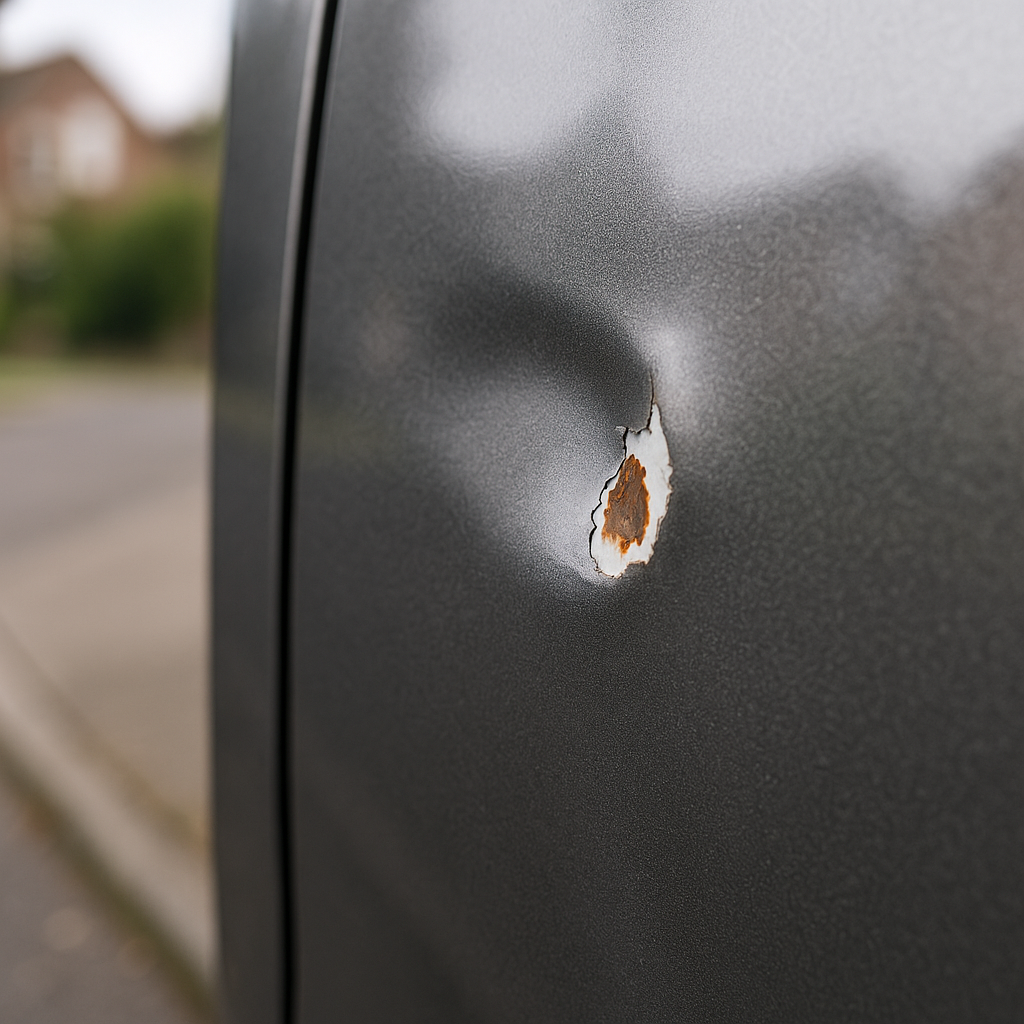
The Salinas Valley gets marine layer moisture off Monterey Bay from roughly October through June. That fog and dampness sits on your car overnight, every night. If a dent has cracked the paint — even slightly — that moisture works into the bare metal and starts the corrosion process.
Rust on a car body doesn’t stay in one place. It spreads under the paint, and by the time you see bubbling or discoloration on the surface, the damage below is already wider than it looks. What started as a $150–$300 dent repair can become a $600–$1,200+ rust repair once the metal needs cutting and patching.
If you’re unsure whether your paint cracked, run your fingernail lightly across the dent. If you feel any roughness, jagged edge, or catch — the clear coat is compromised. That dent is no longer just cosmetic.
Salt air exposure is also a factor for drivers who commute through Monterey or park near the coast regularly. You can read more about how rust spreads and what repair actually involves in this guide on how to fix a rust spot on a car.
When a Small Dent Is Fine to Leave
Not every dent needs immediate attention. Here are the conditions where leaving it alone is a reasonable call:
- The dent is smooth and shallow with no paint damage whatsoever
- It’s on a flat, accessible panel (not near a crease or edge)
- The vehicle is older with existing cosmetic wear and you’re not planning to sell soon
- You’re self-pay and the repair cost doesn’t make financial sense relative to the car’s value
- The dent is in a low-visibility location (under a bumper lip, lower rocker panel on a beater)
In these situations, the dent is a cosmetic issue and nothing more. Monitoring it periodically — especially after wet winter months — is smart, but there’s no urgent repair needed.
That said, “fine to leave” doesn’t mean “fine forever.” If you live or park near the coast, or your commute takes you through the Salinas Valley where morning fog is heavy from November through April, check that dent annually for any sign of paint lift or rust bubbling.
When You Should Definitely See a Body Shop
Some situations take the decision out of the “wait and see” category entirely. Take the dent to a shop when:
- Paint is cracked, chipped, or scraped anywhere in the dent area — bare metal is exposed
- The dent is on an aluminum panel — DIY tools and untrained attempts often make aluminum worse
- The dent is near a door edge, body line, or panel seam — these require professional reshaping to avoid rippling
- The vehicle is under two years old or you plan to sell within the next 12 months — the resale impact is real
- The dent is accompanied by any misalignment of the door, hood, or trunk — that’s a structural question, not just cosmetic
- You’re filing an insurance claim for a parking lot hit — document everything and let the shop handle the scope
For any dent connected to an actual collision — even a minor one — the damage you can see is often not the full picture. A low-speed impact can transfer force to the door frame or panel structure without leaving an obvious mark. That’s worth having a professional eye on. The vehicle dent removal service page covers what a professional evaluation actually looks at.
Small Dent Decision Guide: Fix It or Leave It?
Use this as a quick reference based on the most common dent scenarios Salinas-area drivers deal with.
| Dent Situation | Paint Damage? | Recommended Action |
|---|---|---|
| Shallow round dent, flat panel | No | Monitor or get a PDR estimate — low urgency |
| Dent near a body line or crease | No | Get a shop assessment — harder to fix cleanly later |
| Any dent with cracked or chipped paint | Yes | Repair promptly — rust risk is real |
| Dent on aluminum panel (newer trucks/SUVs) | No or Yes | Body shop only — aluminum needs specialized repair |
| Dent from a parking lot collision | Possibly | Get an estimate — hidden damage is possible |
| Old vehicle, dent in low-visibility spot | No | Leave it — monitor seasonally for rust |
| Vehicle under 2 years old or for sale soon | No or Yes | Repair — resale value impact is measurable |
Paintless Dent Repair vs. Conventional Body Work — What’s the Difference?
When people hear “body shop,” they assume it means sanding, priming, and repainting. That’s not always what happens for small dents.
Paintless dent repair (PDR) is a technique where a technician uses specialized tools to gently push the dent out from behind the panel — no filler, no paint. It works well on:
- Smooth, round dents with no paint damage
- Hail damage (multiple shallow dents across a panel)
- Minor door dings from other vehicles in parking lots
PDR is typically faster and less expensive than conventional body work. A single door ding in Salinas might run $75–$200 for PDR, compared to $300–$600+ for a conventional repair that involves filler and paint.
But PDR has real limits. It doesn’t work on sharp creases, dents near panel edges, or any dent where the paint has cracked. And it absolutely doesn’t work on aluminum panels the same way it works on steel — the material behaves differently under pressure.
Conventional body work — filler, primer, paint, and clear coat — is the right call when the metal is creased, the paint is compromised, or the panel shape can’t be restored by pushing alone. A good technician will tell you upfront which method applies to your specific dent. You can also read more about dent repair on doors to understand the process before you go in.
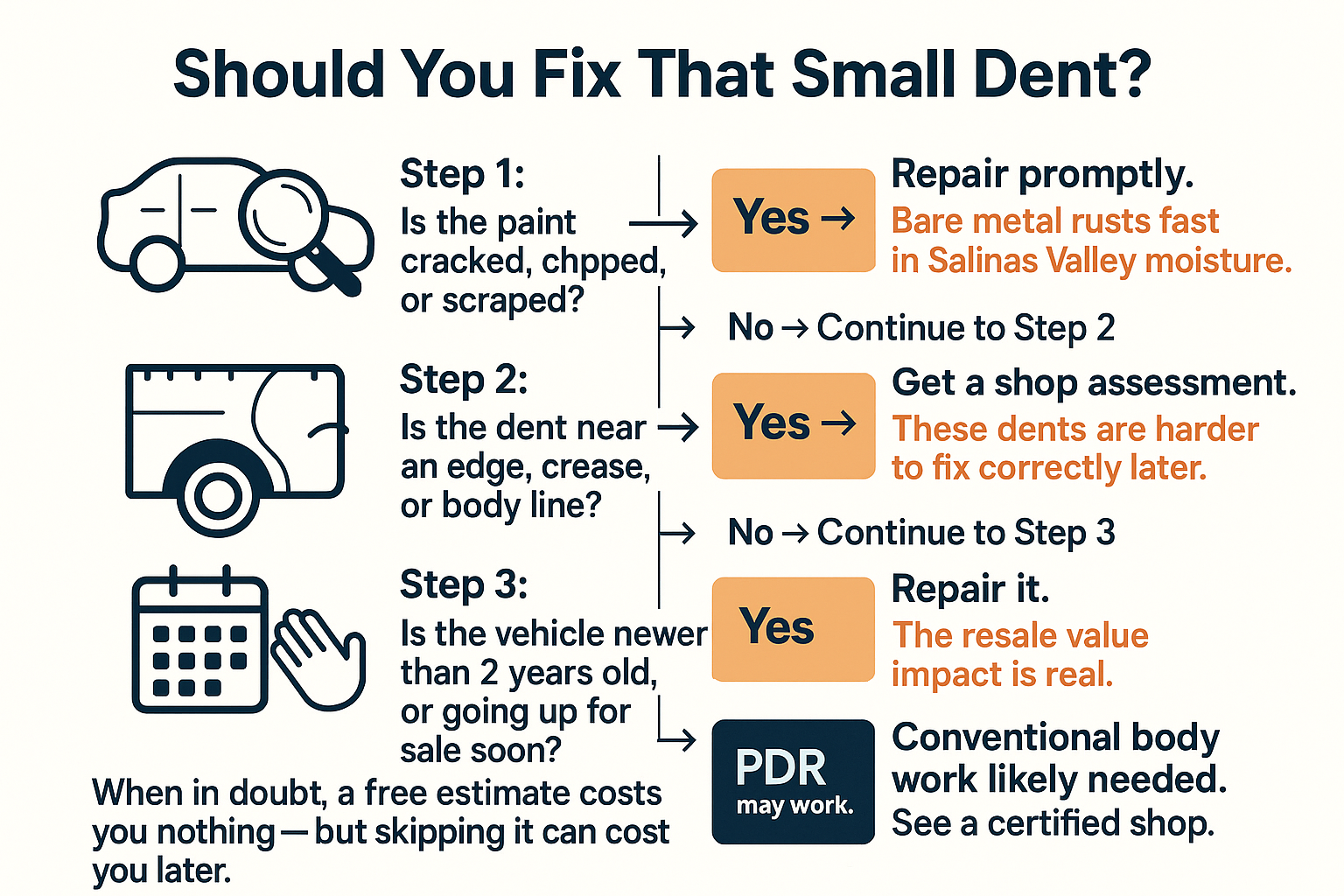
How to Decide: Should You Fix That Dent?
This decision flow walks you through the four questions that determine whether your dent needs a body shop visit.
What Does a Small Dent Repair Actually Cost in the Salinas Area?
Repair costs in Monterey County run slightly above the state average because labor rates here reflect the local cost of doing business. That’s not a complaint — it’s just context for setting realistic expectations.
Here’s a general range for common small dent scenarios:
- Single door ding, PDR eligible: $75–$200
- Small dent with paint damage, one panel: $300–$600
- Dent near a body line requiring conventional repair: $400–$700
- Multiple dents from a parking lot incident: $500–$1,000+ depending on scope
- Dent on aluminum panel: $300–$800 depending on severity and vehicle make
These are real-world ranges, not guarantees. Every dent is different, and the only way to get an accurate number is to have someone look at it in person.
One thing worth knowing: if the damage was caused by another driver — even in a parking lot — you may have an insurance claim available to you. You’re not required to pay out of pocket just because the damage looks minor. Under California Insurance Code § 758.5, you also have the right to choose your own repair shop regardless of what your insurer suggests. For more context on what repairs like this actually cost, this collision repair cost guide breaks it down by damage type.
Frequently Asked Questions About Small Dent Repair
Can I fix a small dent myself with a DIY kit from the auto parts store?
DIY suction cups and dent pullers work on a very narrow range of dents — large, shallow, round dents on flat steel panels. On anything else, they often make the damage worse or leave a stretched area that’s more expensive to fix professionally. If the paint is intact and you want to try, understand the risk before you pull.
Will a small dent affect my car’s resale value?
Yes, measurably. Dealerships and private buyers both discount vehicles with visible body damage. On a vehicle worth $15,000–$25,000, a noticeable dent can reduce an offer by $300–$800 or more depending on its location and severity. On an older high-mileage car, the impact is smaller but still real.
Does insurance cover a small dent from a parking lot?
It depends on your coverage. Collision coverage applies if you were moving when the impact happened. Comprehensive coverage may apply to stationary parking lot damage in some cases. If the other driver is identified and at fault, their liability coverage pays. Always file a report with the other driver’s insurance before assuming you’re paying out of pocket.
How long does a small dent repair take?
A PDR repair on a single dent can often be completed same-day or within one business day. A conventional repair involving paint work typically takes 2–4 business days once parts and materials are staged. Shops will give you a more specific timeline after they’ve assessed the actual damage.
Is paintless dent repair as good as conventional body work?
When it’s the right tool for the job, PDR produces excellent results — in some cases, better than conventional repair because the original paint is untouched. But it’s not appropriate for every dent. A shop that recommends PDR for a crease or a paint-damaged panel is cutting corners. The repair method should match the damage, not the price point.
Not Sure What That Dent Actually Needs?
Searson Collision Center has been assessing and repairing vehicle damage in Salinas since 1963 — and a free estimate costs you nothing but a few minutes. If you’re in the Salinas area or anywhere in Monterey County and want a straight answer about what your dent actually requires, call (831) 422-2460 or visit searsoncollisioncenter.com to schedule your free estimate.