Direct Answer: A scratch requires a full repaint when it cuts through the color coat into the primer or bare metal. Surface scratches that only affect the clear coat can often be polished out without repainting.
You find a scratch on your car and the first question is always the same: do I actually need to pay for paint, or can this be buffed out? It’s a fair question — and the answer depends entirely on how deep the scratch goes, not how long it looks.
In the Salinas area, where parking lots at Northridge Mall and along Main Street see heavy daily traffic, door scratches and paint scuffs are some of the most common damage we see. Most drivers aren’t sure what they’re looking at — and that uncertainty can lead to either overpaying for repairs or ignoring something that’s quietly getting worse.
This article explains how paint layers work, what determines whether a scratch can be polished out versus requiring a full repaint, and what the repair process actually looks like when paint work is unavoidable.
How Your Car’s Paint Is Actually Layered
Most people think of paint as one coat, but your car’s finish is actually built up in distinct layers. Understanding those layers is the key to knowing whether a scratch is a quick fix or a real repair job.
From the outside in, here’s how the finish is stacked:
- Clear coat — the outermost, transparent layer that provides gloss and UV protection
- Color coat (base coat) — this is the actual color you see; it sits under the clear
- Primer — a bonding layer that helps paint adhere to the metal or plastic panel
- Bare metal or substrate — the panel itself
A scratch that only grazes the clear coat hasn’t touched the color. A professional polish or light compound can often remove it entirely. But once a scratch cuts through the color coat — even partially — you’re looking at paint work.
And once bare metal is exposed, repainting isn’t optional. Metal left open to the coastal air in Monterey County, where salt and humidity are a real factor along Highway 1 and the Salinas Valley floor, will start rusting faster than most drivers expect. We’ve seen surface rust begin in a matter of weeks on unprotected scratches. If you’re wondering what that progression looks like, how to fix a rust spot on a car walks through what happens when exposed metal goes untreated.
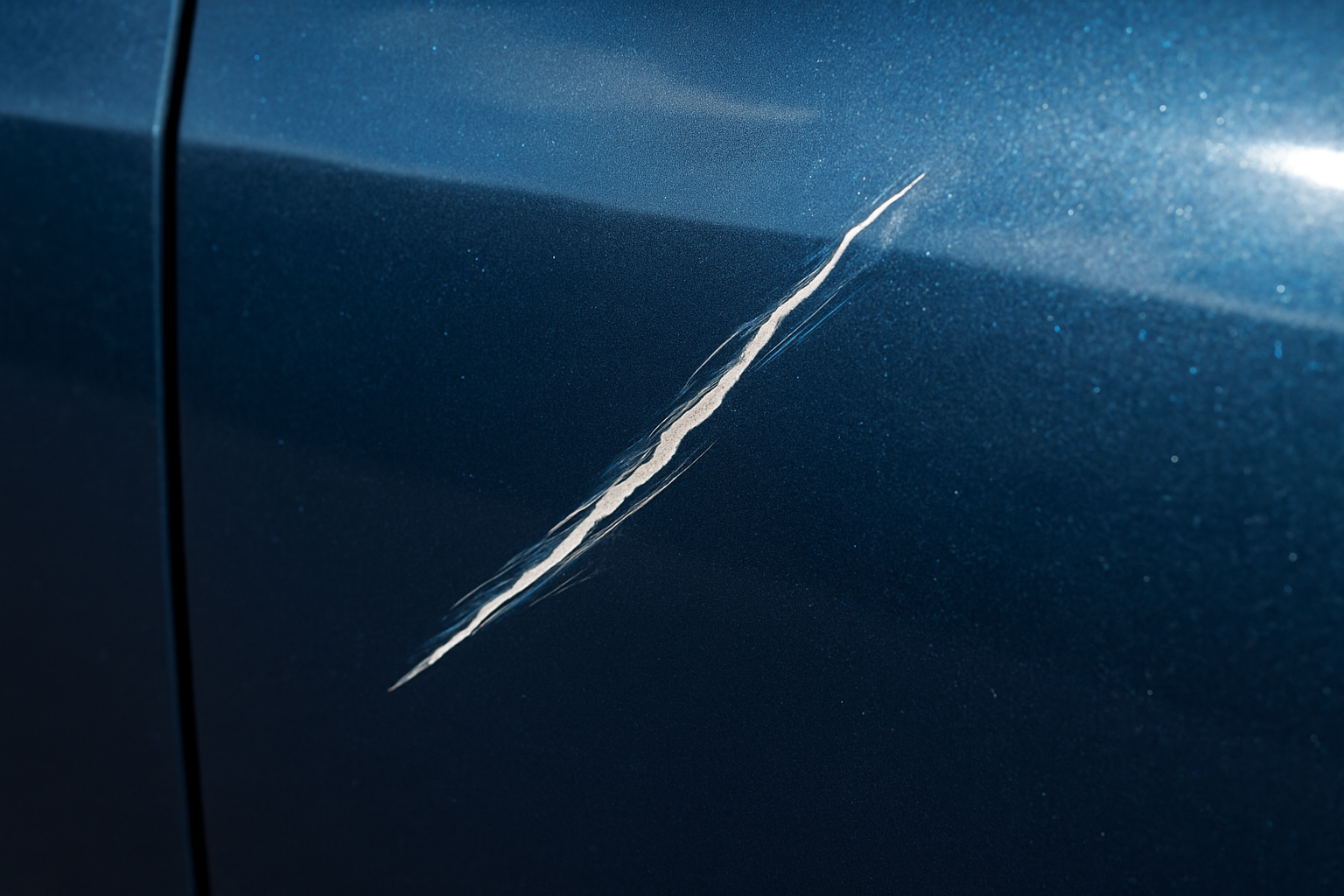
The Fingernail Test and What It Actually Tells You
There’s a simple field check that tells you a lot about a scratch before you ever talk to a shop. Run your fingernail across the scratch at a 90-degree angle — perpendicular to the line, not along it.
If your nail glides smoothly across without catching, the scratch is likely in the clear coat only. The surface texture hasn’t changed, which means the color underneath is intact.
If your nail catches or drops into a groove, the scratch has cut through the clear coat and into the color layer or deeper. That’s the threshold where polishing alone won’t restore the finish.
A few other signs that point toward a repaint:
- The scratch looks white or chalky rather than shiny — that’s the clear coat fractured and clouded
- You can see a different color at the bottom of the scratch, often gray primer or silver bare metal
- The panel feels rough or sharp along the scratch line
- The scratch has any rust or reddish-brown discoloration, even faint
One thing to be aware of: scratch removers and polishing compounds can temporarily fill and mask a deep scratch, making it look better without actually sealing it. The truth about whether scratch remover actually works is worth reading before you put anything on the paint yourself.
Scratch Depth vs. What the Repair Actually Involves
Here’s a quick reference for what different scratch depths typically mean for the repair process and cost range in the Salinas area.
| Scratch Depth | What You See | Typical Repair | Estimated Cost Range |
|---|---|---|---|
| Clear coat only | Hazy or dull line, nail glides over it | Machine polish or compound | $50–$150 |
| Into base coat (color) | White or chalky line, nail catches | Spot paint or panel respray | $200–$600+ |
| Through to primer | Gray or dull band beneath color | Full panel repaint with blend | $400–$900+ |
| Bare metal exposed | Silver or rust showing | Panel repaint, possible rust treatment | $500–$1,200+ |
| Deep scratch + rust | Brown/orange discoloration in scratch | Rust removal, primer, full panel repaint | $600–$1,500+ |
What ‘Full Repaint’ Actually Means for a Single Scratch
When a shop says a scratch needs a repaint, they rarely mean the entire car. In most cases, they mean repainting the affected panel — a single door, a quarter panel, a bumper cover.
The process for a panel repaint typically goes like this:
- The damaged area is sanded down to a clean surface
- Primer is applied and allowed to cure
- Color coat is sprayed in multiple passes to build depth
- Clear coat is applied over the color
- The new paint is blended into adjacent panels to avoid a visible color seam
That blending step is where most of the skill — and cost — lives. Your car’s paint has likely faded slightly since it left the factory, especially on older vehicles or ones that spend a lot of time in the sun along the Salinas Valley. A shop has to account for that existing fade when mixing and applying new color. How shops match paint on a car that’s already faded explains that process in more detail.
For a single panel repaint with blending on a mid-size sedan in Salinas, expect to pay somewhere in the $400–$900 range depending on panel size, color complexity, and whether rust treatment is involved. Metallic and pearl colors cost more because they require additional color coats and more precise matching.
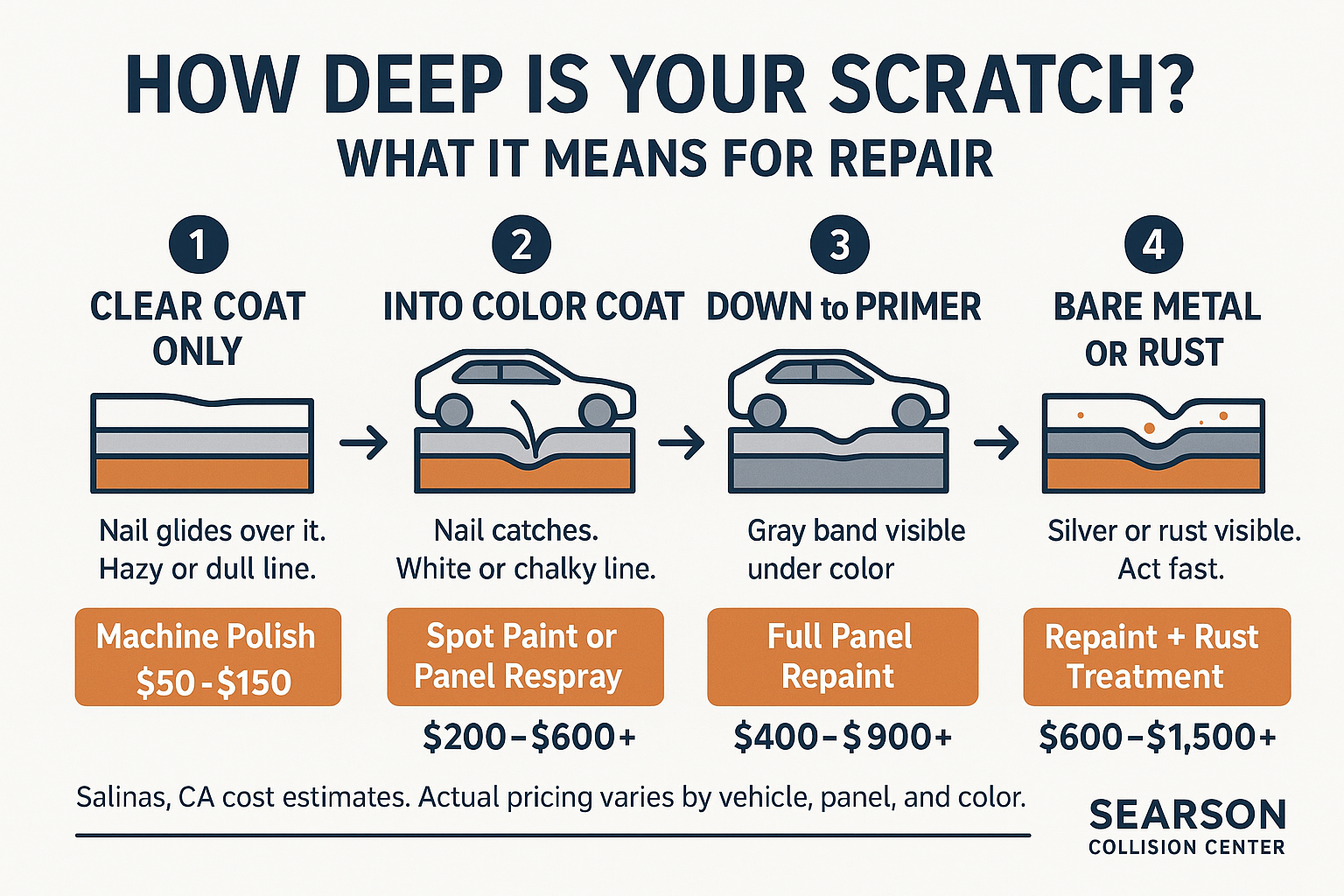
How Deep Is Your Scratch? A Quick Visual Guide
This infographic shows the four scratch depth levels, what each one looks like from the outside, and what type of repair each one requires.
When Insurance Covers a Scratch — and When It Doesn’t
Whether your insurance covers a scratch depends almost entirely on how it happened and what coverage you carry.
Comprehensive coverage typically covers scratches caused by things outside your control — a shopping cart, vandalism, road debris, a tree branch. Collision coverage covers damage from an actual impact with another vehicle or object. If you just found a mystery scratch in a parking lot with no idea how it got there, comprehensive is usually the applicable coverage.
If you only carry liability insurance, paint damage to your own car isn’t covered at all unless the at-fault party’s insurance pays for it.
One thing worth knowing: California law gives you the right to choose your own repair shop regardless of what your insurer suggests. Under California Insurance Code § 758.5, no insurance company can require you to use a specific shop. Does your insurance company actually get to choose where your car is repaired? covers that protection in plain terms.
For minor cosmetic scratches where the repair cost is close to your deductible — say a $500 deductible against a $400 scratch repair — it often makes more financial sense to pay out of pocket and avoid a claim on your record. A shop can give you a written estimate for free so you can make that call with real numbers in hand.
Frequently Asked Questions About Scratch Repair and Repainting
Can a body shop fix a scratch without repainting the whole panel?
Sometimes, yes. If the scratch is small and only in the clear coat, a polish or spot treatment may be enough. But if the scratch has cut into the color coat, most shops will recommend repainting the full panel for a clean result. Spot-painting a small area without blending into the surrounding panel almost always leaves a visible patch, especially on darker or metallic colors.
What happens if I just leave a deep scratch alone?
If the scratch has broken through to bare metal, leaving it alone invites rust. Monterey County’s coastal air — especially for drivers who live near the bay or commute along Highway 1 — accelerates that process. A scratch that could have been repaired for $400–$600 can become a rust repair job at $800–$1,500 if it’s ignored for a season or two.
Will the new paint match the rest of my car?
A well-equipped shop with experienced painters can get very close, but an exact match on an older vehicle requires skill and the right equipment. Paint fades over time, so the new color coat has to be blended into adjacent panels to avoid a visible seam. This is standard practice at shops that do quality paint work, and it’s part of what separates a quality repair from a cheap one.
Does scratch remover from the auto parts store actually fix scratches?
For very light clear coat scratches, it can reduce the appearance. But for anything that’s cut into the color coat, scratch remover fills the groove temporarily without actually sealing the paint. It can make a scratch look better for a few weeks, then fade back. And on some finishes, aggressive compounds can create swirl marks or dull the surrounding clear coat. It’s a short-term cosmetic fix, not a structural repair.
How long does a panel repaint take?
For a straightforward single-panel repaint with no rust work, most shops complete the job in 2–3 business days. If rust treatment or significant prep work is needed, plan for 3–5 days. Shops handling insurance claims may have slightly longer turnaround depending on adjuster scheduling.
Is a scratch considered collision damage or comprehensive?
It depends on the cause. A scratch from hitting something — a post, another car, a curb — falls under collision coverage. A scratch from vandalism, a shopping cart, or an unknown cause in a parking lot typically falls under comprehensive. If you’re unsure how to file, how to file a car insurance claim walks through the process step by step.
Not Sure What You’re Looking At?
Bring your car by Searson Collision Center at 488 Brunken Ave in Salinas and we’ll take a look at no charge. We’ll tell you exactly what the scratch has done to the paint, whether a polish might handle it, and what a repair would involve if paint work is needed — no pressure, just a straight answer. Call us at (831) 422-2460 or visit searsoncollisioncenter.com to schedule your free estimate.