Direct Answer: A bumper impact can crack, shift, or destroy sensors embedded in the bumper cover — even if the cover looks fine. Those sensors control parking alerts, blind spot monitoring, and your backup camera.
You backed into a post in a Northridge Mall parking lot, or maybe someone tapped your rear end on southbound 101 near the Salinas offramp. The bumper cover looks okay — maybe a scuff, maybe a hairline crack. But now your parking alerts are going off randomly, or they’ve gone completely silent. That’s your sensors telling you something is wrong.
Modern vehicles pack a lot of electronics into that bumper — parking sensors, cross-traffic alert sensors, blind spot monitors, and sometimes the radar module for adaptive cruise control. All of them sit right in the impact zone. A collision that barely dents the cover can still crack a sensor housing, knock a sensor out of alignment, or sever the wiring harness behind it.
This article explains what actually fails in a bumper sensor system after a hit, how shops diagnose it, and what you can realistically expect to pay for repairs in Monterey County.
What’s Actually Inside Your Bumper
Most drivers think of the bumper as one piece. In reality, it’s a system with several layers — and the sensors are buried inside all of it.
From the outside in, a modern rear bumper typically includes:
- The bumper cover — the painted plastic shell you see
- The bumper absorber — a foam or plastic energy-absorbing layer directly behind the cover
- The bumper reinforcement bar — the structural steel or aluminum beam bolted to the frame
- Sensor mounting brackets — plastic clips that hold each sensor to the cover at a specific angle
- The wiring harness — the cable that connects each sensor back to the control module
Parking sensors are press-fit into holes drilled through the cover. They sit flush with the surface, and they depend on precise alignment to work correctly. When the cover flexes, cracks, or shifts during impact, those sensors can twist in their brackets, crack internally, or get pinched by the damaged foam absorber behind them.
And the wiring runs directly behind the absorber. In a harder hit, that harness can tear at the connector or get crushed between the reinforcement bar and the foam — even if there’s no visible body damage from outside. That’s why a cracked bumper that still looks drivable may already have compromised electronics inside.
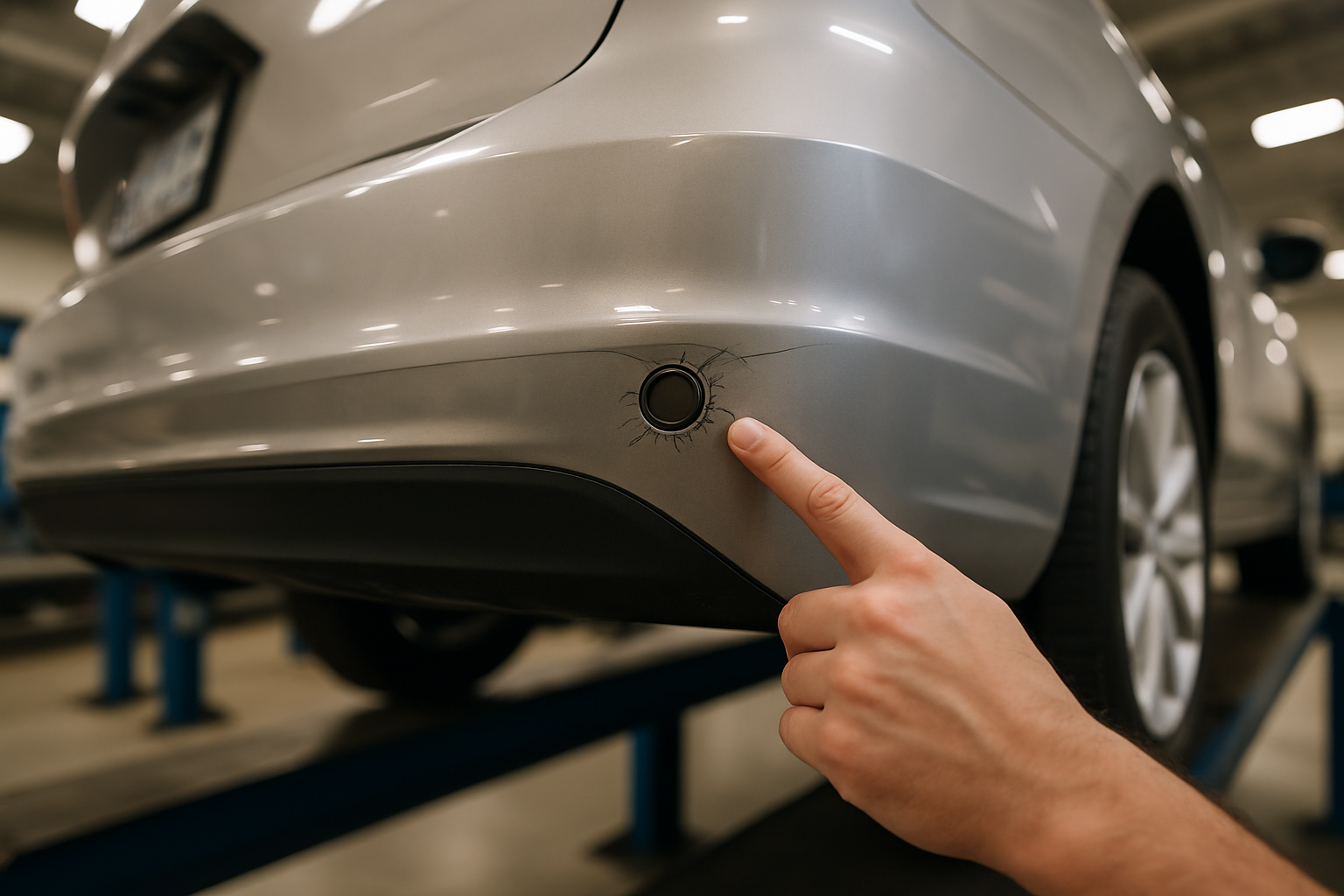
How Sensor Damage Shows Up After a Collision
The frustrating part is that sensor problems don’t always show up immediately. Sometimes a sensor that was cracked in a hit will work fine for a few weeks, then fail when moisture gets into the housing. Other times you’ll walk out to your car the next morning and see a warning light that wasn’t there the day before.
Common signs that sensors were affected by a bumper hit:
- Parking sensor beeps constantly even when nothing is behind you
- Parking alert system is completely silent where it used to chime
- A yellow or red sensor warning icon on the dashboard
- Backup camera shows a black screen or distorted image (the camera is typically mounted in or near the rear bumper)
- Blind spot indicators stop working on the side that took the hit
- Adaptive cruise control disables itself after a front bumper impact (the radar module often sits behind the front grille or lower bumper)
If your car only shows one or two of these symptoms, the likely culprit is a single sensor or a connector that got knocked loose. If multiple systems are failing at once, the harness or the control module itself may have taken damage — which pushes the repair cost significantly higher.
For context on what a full bumper repair involves beyond just the sensors, the car accident repair process guide covers what shops are actually working through from estimate to pickup.
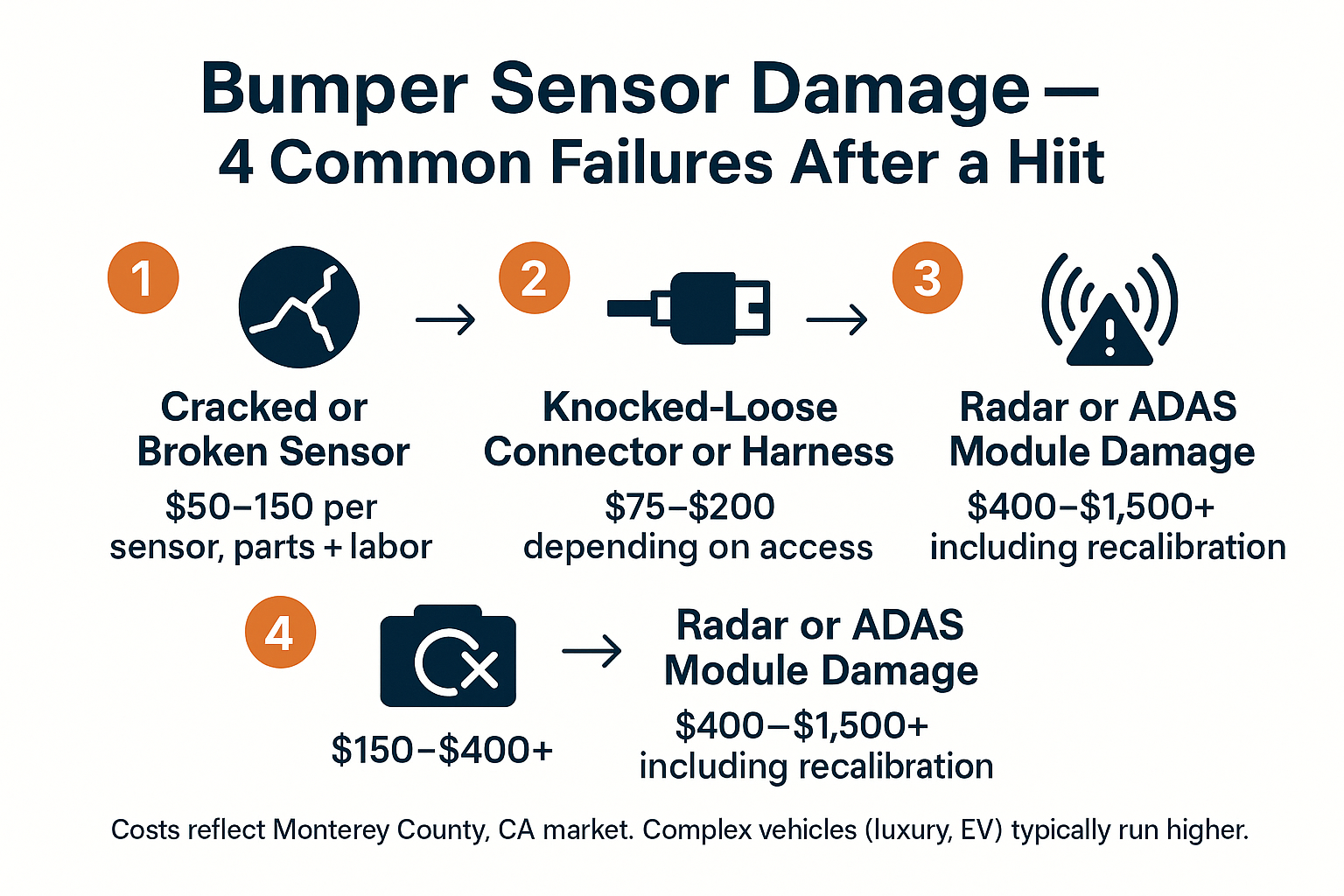
Bumper Impact: What Can Break and Where
This infographic maps out the four most common sensor-related failures after a bumper hit, from the most minor to the most costly.
Bumper Sensor Repair Costs in the Salinas Area
These are realistic cost ranges for sensor-related repairs at a qualified body shop in Monterey County, CA. Actual costs depend on vehicle make, model year, and whether recalibration is required.
| Repair Type | Typical Cost Range | Notes |
|---|---|---|
| Single parking sensor replacement | $50–$150 | Parts vary widely by OEM vs. aftermarket |
| Full rear sensor set (4 sensors) | $180–$450 | Common after moderate rear impacts |
| Backup camera replacement | $150–$400+ | Higher on luxury/integrated displays |
| Wiring harness repair | $100–$300 | Depends on damage length and routing |
| ADAS radar module replacement | $400–$1,200 | Calibration usually required after replacement |
| ADAS system recalibration only | $150–$350 | Required even if module wasn’t replaced |
Why Recalibration Matters — and What Happens If It’s Skipped
Replacing a sensor isn’t always the finish line. Many modern driver assistance systems — adaptive cruise control, lane departure warning, forward collision alert — rely on sensors that need to be pointed at very precise angles to work correctly. When you replace those sensors or reassemble a bumper after a hit, that alignment resets to zero. Recalibration is the process of pointing the sensor back to factory spec using a scan tool and physical targets.
Skipping calibration is one of the more common shortcuts in collision repair, and it has real consequences. A forward radar that’s off by a small degree will either brake too late or false-trigger when there’s nothing in front of you. A blind-spot sensor that isn’t calibrated may stop alerting you to vehicles in your lane on Highway 68 heading into Monterey — exactly the kind of road where that warning matters.
California doesn’t have a specific law mandating ADAS recalibration after a collision, but I-CAR Gold Class certification — which Searson Collision Center holds — requires technicians to follow OEM repair procedures, and virtually every automaker’s OEM procedures specify recalibration after any sensor replacement or bumper reassembly.
If you’re reviewing a repair estimate and it lists new sensors with no mention of calibration, that’s a conversation worth having before you approve the work. Shops that skip this step aren’t just cutting corners on the sensor — they’re cutting corners on the systems those sensors feed. You can see how this fits into the broader picture of what a shop handles on your vehicle in this article on what actually happens between drop-off and pickup at a body shop.
Does Insurance Cover Sensor Repair After a Collision?
Yes — if the sensors were damaged in the collision, they’re part of the claim. Under California insurance law, your vehicle must be restored to pre-accident condition. A parking sensor or backup camera that worked before the hit and doesn’t work after is a covered item under a standard collision or liability claim.
Where it gets complicated is with supplements. Many initial estimates focus on visible body damage — the cover, the paint, the reinforcement bar. Sensor damage often doesn’t show up until the bumper is pulled apart for repair. When the shop discovers a cracked sensor housing or a torn harness, they file a supplement with the insurer to add those items to the claim.
That’s a normal part of the process, not a red flag. But it does mean your initial estimate may not reflect the full cost. It also means the timeline may extend a few days while the insurer reviews and approves the supplement.
And if you’re being steered toward a specific shop by your insurer, it’s worth knowing that under California Insurance Code § 758.5, you have the right to choose any licensed repair facility you want. The insurer cannot require you to use their preferred shop. For more on how that works, this breakdown of whether your insurance company actually gets to choose where your car is repaired explains your rights in plain terms.
Frequently Asked Questions About Bumper Sensor Damage
Can a sensor fail even if there’s no visible damage to the bumper?
Yes, and this happens more often than people expect. The sensor housing can crack internally from the force of impact even when the painted cover looks fine. The wiring harness can also get pinched behind the absorber without leaving a mark on the outside. If your parking alerts or backup camera are acting up after any bump, have the sensors checked regardless of how the bumper looks.
How long does it take to replace bumper sensors?
A straightforward sensor swap on a common vehicle can be done same-day. But if the shop needs to order sensors specific to your make and model — especially on newer vehicles or luxury brands — that part can take 1–3 business days to arrive. If recalibration is required, add a few hours on top of the installation time.
Will aftermarket sensors work the same as the original ones?
Sometimes, but not always. Aftermarket sensors are often fine for basic proximity alerts on older vehicles. On newer cars with integrated ADAS systems — adaptive cruise control, automatic emergency braking, blind spot monitoring — the factory recommends OEM sensors because third-party units may not communicate correctly with the vehicle’s control modules. A shop following OEM repair procedures will tell you if aftermarket is acceptable for your specific car.
What’s ADAS, and why does it keep coming up in repair estimates?
ADAS stands for Advanced Driver Assistance Systems — the umbrella term for all the electronic safety features that use sensors and cameras to monitor your surroundings. Adaptive cruise control, automatic emergency braking, lane-keep assist, and blind spot monitoring all fall under ADAS. These systems are increasingly common even on non-luxury vehicles. When an estimate mentions ADAS recalibration, it means the sensors that run those systems need to be re-aimed to factory specifications after the repair — a step that requires specialized equipment.
Can I drive with a failed parking sensor until I get it fixed?
You can drive, but it depends on which sensor failed and what it controls. A rear parking alert that beeps while backing up is inconvenient to lose, but it won’t prevent you from driving. A forward radar module that feeds your automatic emergency braking system is a more serious concern — that system may disable itself or behave unpredictably without a functioning sensor. Check your dashboard warnings and, when in doubt, ask the shop before putting miles on the car.
Does sensor replacement affect my paint or bumper finish?
Sensors are press-fit into pre-drilled holes in the bumper cover, so replacement doesn’t require cutting or repainting unless the cover itself was damaged. If the bumper cover needs to come off and go back on, a good shop will inspect the paint edges around each sensor hole while they’re in there.
Get Your Sensors Checked at the Source
If your parking alerts or driver assistance systems started acting up after a bump, a quick inspection at Searson Collision Center can tell you exactly what failed and what it’ll take to fix it. The shop has been handling collision repairs on Brunken Ave in Salinas since 1963, and the team knows how to pull an estimate that covers what’s actually damaged — sensors, harness, and all. Call (831) 422-2460 or visit searsoncollisioncenter.com to schedule your free estimate.