Quick Answer
In 2026, collision repair costs can range from a few hundred dollars for minor cosmetic work to over $10,000 for major structural damage. A typical fender-bender involving a bumper, fender, and headlight often falls between $2,500 and $5,000. The final price depends heavily on five factors: the cost of parts (OEM vs. aftermarket), labor rates, the complexity of the paint job, whether there is frame or structural damage, and the need to recalibrate modern electronic safety systems (ADAS). Your out-of-pocket expense will be determined by your insurance deductible.
After an accident, drivers often ask the same thing within the first few minutes. How much does collision repair cost, and how bad is this going to get? That’s a fair question, especially when the car is damaged, the insurance company is calling, and you still need to get to work tomorrow.
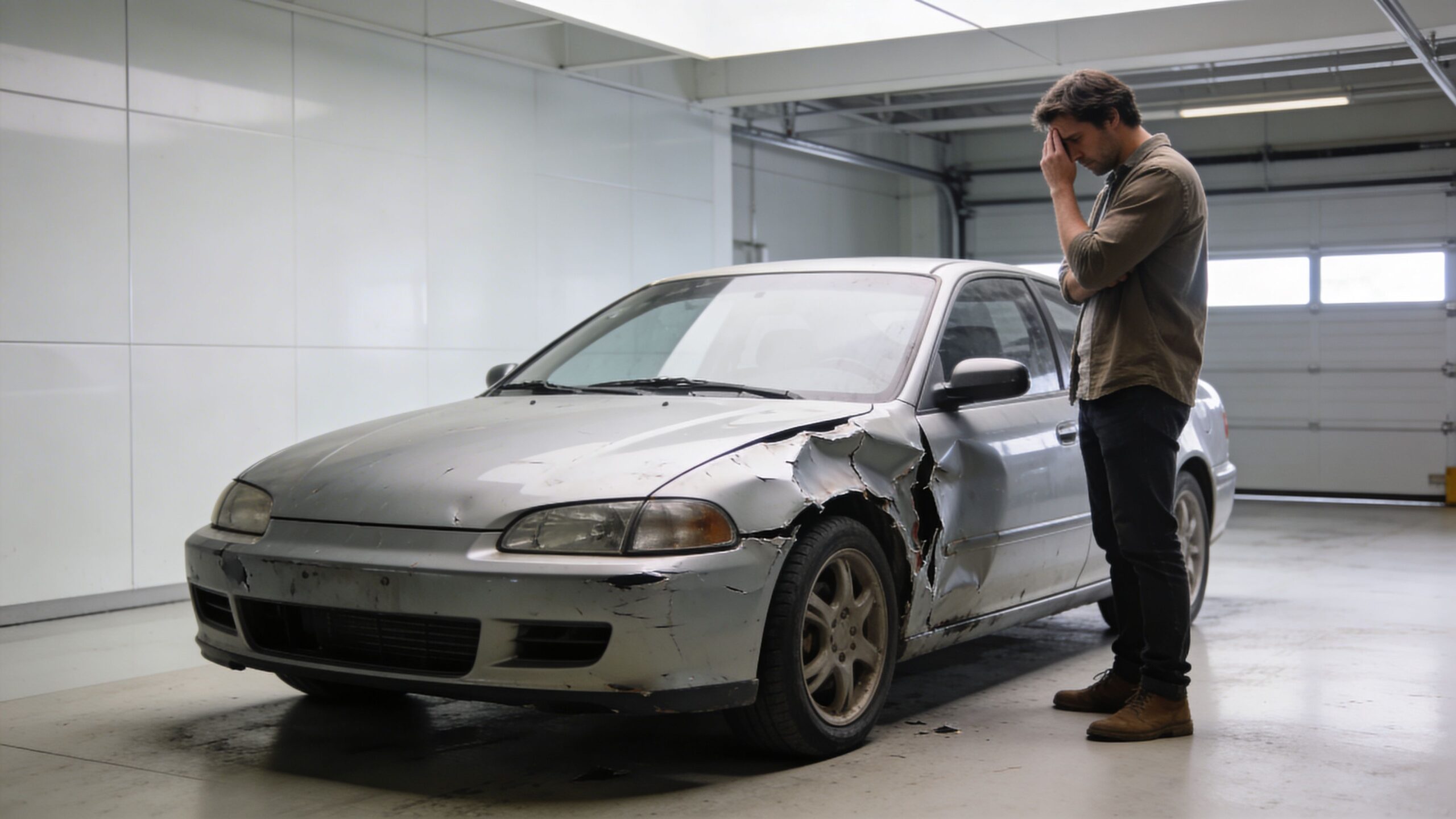
The short answer is that collision repair can vary a lot. The national average cost for auto body repairs is about $4,700 (Enlyte, 2024), but averages only tell you so much. A scuffed bumper and a bent front rail don’t belong in the same conversation, even if both happened in a “minor” crash.
What helps is understanding where the money goes. Once you see how shops build an estimate, the numbers make more sense, and you can spot the difference between a careful repair and a shortcut. Around Salinas and the Monterey Bay Area, that matters, because labor, parts availability, and modern vehicle technology all play into the final bill.
Understanding Collision Repair Cost Ranges by Damage Level
A lot of confusion starts when people hear one number and assume it applies to every accident. It doesn’t. Cost follows damage level first.
Minor cosmetic repairs can be under $1,500, moderate damage often falls between $1,500 and $4,000, and major structural work frequently exceeds $6,000 (Dietrich's Collision, 2025). That’s the broad picture. Here’s a more practical way to look at it.
A quick view of common repair scenarios
| Damage Level | Common Examples | Estimated Cost Range |
|---|---|---|
| Minor | Light scratches, small dents, paint touch-ups, minor bumper scuffs | Under $1,500 |
| Moderate | Bumper replacement, damaged fender or door, multi-panel paint work, moderate side impact | $1,500 to $4,000 |
| Major | Frame damage, structural repair, heavy front-end collision, significant suspension or safety system damage | Exceeds $6,000 |
Minor damage usually looks simple because it is simple
Minor damage is the kind of thing people get in parking lots, driveways, or low-speed taps. A scrape in the paint, a shallow dent, or a bumper cover that needs refinishing usually stays on the lower end.
That said, “minor” only applies if the damage is on the surface. On newer vehicles, what looks like a small bumper hit can involve brackets, sensor mounts, trim pieces, and paint blending into nearby panels.
Practical rule: If the damage is only skin deep, the bill usually stays manageable. If the impact moved parts underneath, the estimate changes fast.
Moderate damage is where estimates start to spread out
This is the category that catches people off guard. A front corner hit may damage the bumper, fender, headlamp area, liner, and mounting points all at once. From the outside, it can look like one damaged area. On the estimate, it shows up as several operations.
Paint work also matters here. A single panel is one thing. Matching color across adjacent panels is another. That’s why two cars with similar dents can end up with different totals.
Major damage means the structure is part of the repair
Once the impact reaches the vehicle’s structure, the job changes. The shop may need measuring, pulling, replacement of structural parts, suspension checks, and safety system verification before refinishing even begins.
If you’re not sure whether you’re dealing with cosmetic damage or something more serious, this guide on how to tell if your car frame is bent is worth a look. Frame and structural issues aren’t always obvious from a quick walkaround.
Why this matters before you approve anything
Customers get frustrated when they expect a small repair and hear a number that belongs in the next category up. Usually that happens because they’re pricing the visible damage, while the estimate has to account for the whole repair.
A good estimate doesn’t just price what you can see. It prices what it takes to put the vehicle back together correctly.
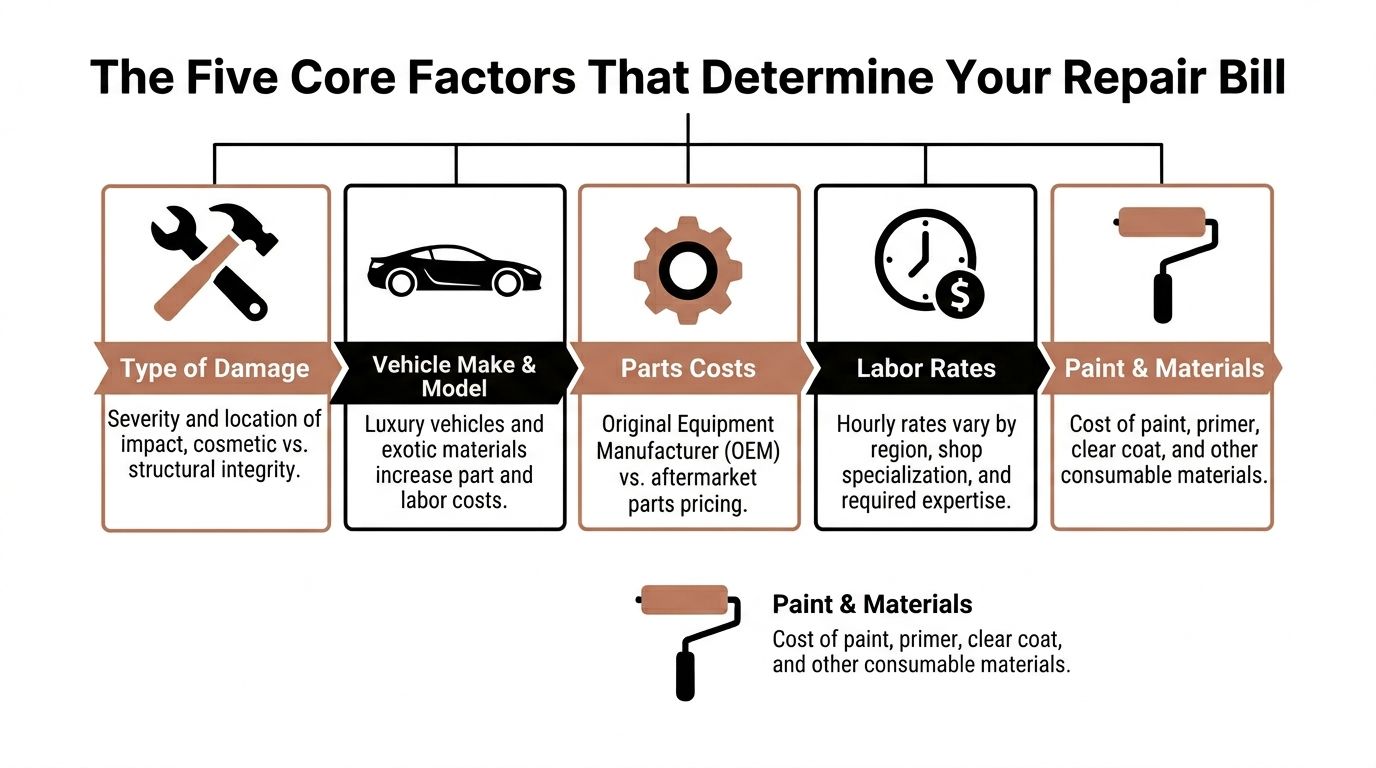
The Five Core Factors That Determine Your Repair Bill
Two cars can come in with damage that looks similar from ten feet away and leave with very different invoices. That’s normal. The bill depends less on the story of the accident and more on what the repair requires.
Parts choice changes the job before the wrench comes out
Parts are one of the first big cost drivers. The basic choices are OEM, aftermarket, and recycled OEM parts. Each has a place, but they’re not interchangeable in every situation.
OEM parts can cost 40 to 60 percent more than aftermarket parts, but they often fit better and can reduce extra labor caused by poor fit or adjustment (CCC Intelligent Solutions, 2025). On structural areas, safety-related components, or vehicles with tight tolerances, fit matters more than the sticker price.
For some cosmetic parts, a quality recycled OEM part can be a sensible middle ground. If it’s the right part, in the right condition, and verified correctly, it can help control cost without creating more work later.
Labor is not just time. It’s trained time
People sometimes look at labor and think it’s just hours on a sheet. It isn’t. Labor reflects what the technician has to know, what equipment the shop has to maintain, and how involved the repair is once the vehicle is apart.
Modern repairs include more than panel replacement and paint. Shops deal with unibody measurements, suspension angles, bonding procedures, corrosion protection, seam sealing, weld locations, and manufacturer repair steps. Those tasks don’t show from the outside, but they’re part of what makes the vehicle safe and complete.
The cheaper estimate isn’t always cheaper in the end. Sometimes it just leaves out procedures that show up later.
Paint and refinishing are more technical than often assumed
Customers often think of paint as the final cosmetic step. In reality, refinishing is a repair process of its own. Surface prep, primer, sealer, basecoat, clear coat, blend panels, curing time, and material use all add up.
Color match is another factor. Solid white is one thing. Metallics, pearls, tri-coats, and older finishes that have weathered in the sun take more work to blend properly. If the repair touches one panel but the color has to be blended into the next, the paint portion grows even if the metal damage didn’t look severe.
Structural damage changes everything underneath
A bumper cover is replaceable. A bent structural component is a different level of repair. Once the hit reaches rails, aprons, reinforcement areas, mounting points, or suspension pickup locations, the shop has to verify dimensions and restore the vehicle’s geometry.
That’s why a car can drive after a collision and still need major structural work. Drivable doesn’t mean undamaged. It only means it still moves.
A good structural repair also affects everything else that comes later. Panel fit, wheel alignment, road tracking, and ADAS performance all depend on the structure being right first.
Electronics and ADAS are the cost factor people miss most
This is the one that surprises customers most often. Many newer vehicles have cameras, radar units, parking sensors, blind-spot systems, lane assistance, and collision warning features built into areas that used to be simple body parts.
ADAS recalibration can add $500 to $2,000 or more to a repair bill, and pre-repair scans are now included in over 90 percent of estimates (CCC Intelligent Solutions, 2025). That means a bumper job isn’t always just a bumper job anymore.
If a sensor sits behind the bumper cover, in the grille, near the windshield, or in a side mirror, the system may need scanning, aiming, calibration, or validation after repairs. That work is not optional if the system was affected.
Vehicle make and model can raise or lower every category
A repair on an economy sedan and a repair on a luxury SUV may look similar on paper, but the bill often won’t. Some vehicles use more expensive materials, proprietary hardware, or manufacturer procedures that take longer and require specific parts.
Luxury vehicles can cost about three times more than economy models in collision repair, especially when proprietary components and specialized labor are involved (OttoFixit, 2026 projection). Aluminum panels, high-strength steel, specialty headlamps, and advanced electronics all push cost upward.
Hidden damage is the reason first estimates move
No honest shop can see everything before teardown. Once covers, lamps, liners, and trim come off, the shop may find broken tabs, crushed absorbers, bent brackets, damaged reinforcements, or structural movement that wasn’t visible.
That’s not a trick. That’s collision repair. The outside tells part of the story. The disassembly tells the rest.
The five factors in plain language
- Parts availability: The right part may be OEM, aftermarket, or recycled, and each choice affects fit, time, and price.
- Labor complexity: Some jobs are straightforward. Others require structural setup, diagnostics, or specialty procedures.
- Paint work: Color match and blending often separate a clean repair from one you notice every time you walk up to the car.
- Structural involvement: Once the hit reaches the vehicle underneath, the repair gets more technical.
- Electronic systems: Cameras and sensors add steps that older vehicles never needed.
If you want the shortest version, here it is. Collision repair costs what the vehicle requires to be repaired correctly, not what the damage looks like from the curb.
How Insurance Deductibles and Claims Affect Your Cost
For many, the number that matters most is the one they personally have to pay. That’s where insurance comes in, and it’s also where a lot of confusion starts.

Your deductible is usually your main out-of-pocket cost
If you’re using your collision coverage, the deductible is the amount you pay before insurance covers the rest of the approved repair. Average deductibles rose from $670 in early 2022 to $697 in 2023 (Relux Collision summary of industry data, 2025).
That doesn’t mean your deductible is that exact number. Your policy controls that. But it does show why more drivers are asking hard questions about whether to file a claim.
The insurer’s first number is not always the final number
An initial insurance estimate is often based on photos or a limited visual inspection. That gets the claim moving, but it doesn’t always capture what’s behind the damaged area.
When the shop disassembles the vehicle and finds collision-related damage that couldn’t be seen at first, it sends a supplement to the insurer. That’s a normal part of the process. It isn’t the shop changing its mind. It’s the repair becoming more complete as the vehicle comes apart.
A supplement usually means hidden damage was found, not that someone padded the bill.
Rental coverage and timing can become real headaches
Even when repair costs are approved, people run into trouble with rental limits, delays in supplemental approvals, or misunderstandings about what the policy covers. That’s why two customers with similar damage can have very different experiences.
If you’re sorting out insurance questions beyond collision damage, this article on does liability insurance cover windshield replacement helps explain how coverage changes depending on the type of claim.
In California, you can choose your own shop
This part is important. Under California Insurance Code § 758.5, an insurer can’t require you to use a specific repair shop. They can suggest a shop in their program, but the decision is yours.
That matters when you feel pushed toward speed over thoroughness. You’re allowed to choose the shop you trust to repair the vehicle properly and communicate clearly with you during the claim.
What helps the process go smoother
A few simple habits make claims easier:
- Keep the claim number handy: Every conversation goes faster when the shop and insurer can tie updates to the right file.
- Ask whether the estimate includes teardown findings: If not, understand that a supplement may follow.
- Confirm rental coverage early: Don’t wait until the car is already in the shop.
- Read the authorization before signing: Make sure you understand what work is being approved and how supplements will be handled.
Insurance can help with the big number. It doesn’t remove the need for a careful repair or a clear conversation.
A Step-by-Step Guide to Getting an Accurate Estimate
The best estimate is not the fastest one. It’s the one that reflects the actual repair.
Step 1 starts with a visual inspection
A photo estimate can be useful for a rough first pass. It helps identify obvious damage and gives the customer or insurer a starting point. But that’s all it is. A start.
If the bumper is pushed in, the lamp is broken, or a panel gap is off, there may be hidden damage underneath. No photo can confirm every broken bracket, reinforcement, or sensor mount.
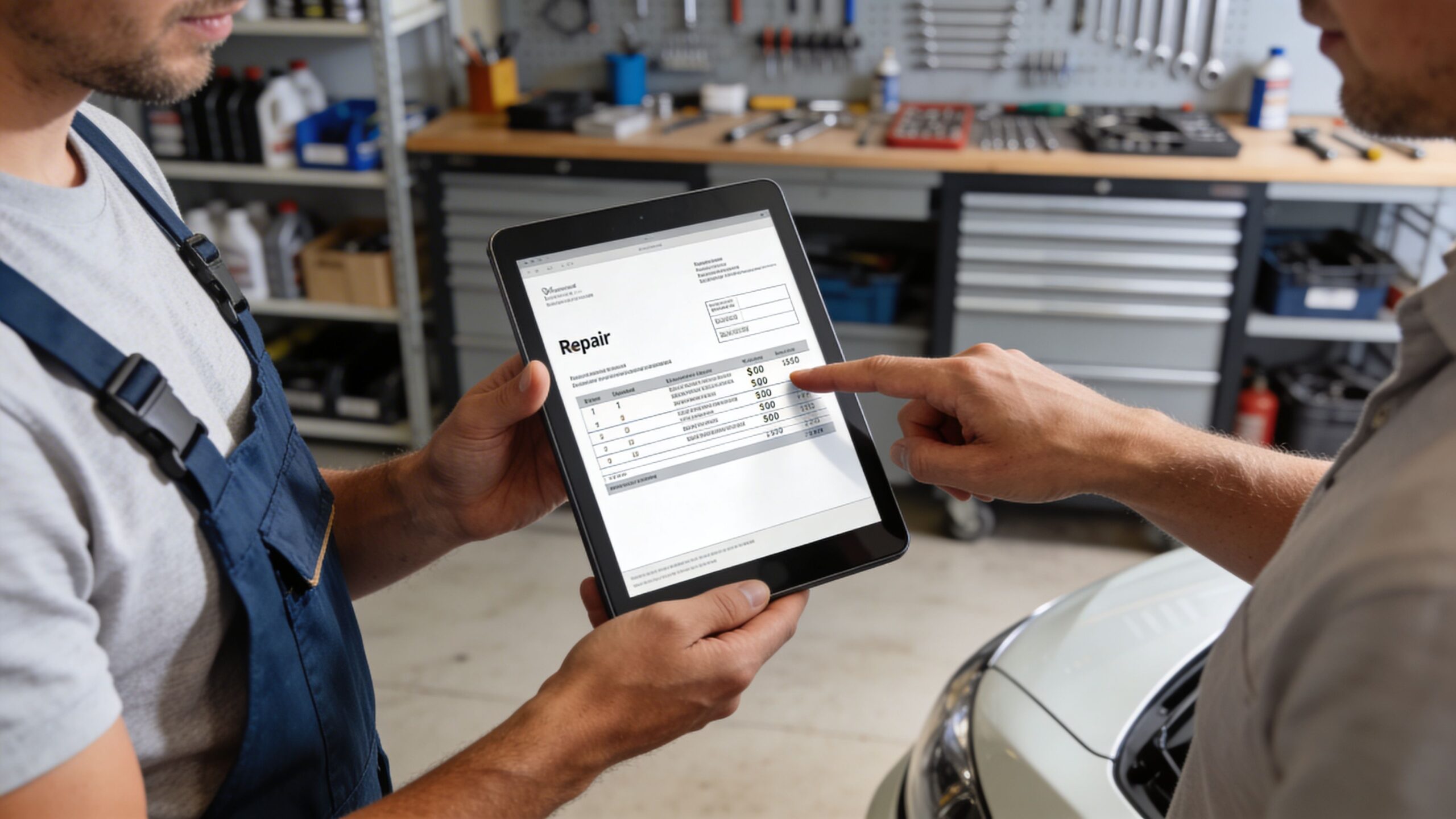
Step 2 is getting a written estimate with real line items
A proper estimate should break the repair into parts, labor operations, paint materials, and related procedures. If you only get a lump-sum number, ask for more detail.
Look for itemized entries that show what is being repaired, what is being replaced, and what may still depend on teardown. If you want a sense of how estimate differences happen, this article on a Caliber Collision estimate gives a useful comparison point.
Step 3 is understanding what teardown reveals
Teardown means removing damaged components so the shop can inspect what sits behind them. Hidden collision damage often appears at this stage. It’s also where many supplements begin.
A lot of customers hear “supplement” and think somebody missed something obvious. Sometimes that’s true. More often, the damage wasn’t visible until parts came off.
The most accurate estimate usually comes after some disassembly, not before it.
Step 4 is checking whether the estimate follows the repair, not just the appearance
A cheap estimate may look attractive because it leaves out procedures that don’t show on the outside. But if the estimate ignores calibrations, corrosion protection, blend work, or structural verification, it may not reflect the complete repair.
That doesn’t mean every estimate should be high. It means it should be complete.
Step 5 is asking the right questions before approval
Before you sign off, ask these:
- Are the parts OEM, aftermarket, or recycled?
- Does this estimate include scans or calibrations if needed?
- What items could change after teardown?
- Will you communicate with my insurer on supplements?
- What warranty applies to the repair?
One factual option in Salinas is Searson Collision Center, which provides free estimates and insurance claim assistance as part of its collision repair process. What matters most is that whichever shop you choose explains the estimate clearly and puts the likely variables in writing.
Common Pitfalls to Avoid and Tips for Managing Costs
When people want to save money, they often make decisions that cost more later. That’s especially true after an accident, when everybody wants the car fixed quickly and the paperwork off the table.
The lowest estimate can be the most expensive path
A low first estimate may mean important items weren’t included yet. Missing labor operations, omitted calibrations, or poor-fit parts can lead to delays, supplements, and redo work.
Parts choice becomes critical here. OEM parts can cost 40 to 60 percent more than aftermarket alternatives, but they can also reduce fit problems and extra labor (CCC Intelligent Solutions, 2025). The cheapest part on paper isn’t always the least expensive repair once installation and finish are considered.
Don’t let anyone rush you into a shop choice
Insurers can recommend shops. They can’t make the choice for you. If you feel pressured, slow the conversation down and ask direct questions about procedures, parts, and what happens if hidden damage is found.
Be smart about where to save and where not to
There are reasonable ways to manage cost without cutting corners.
- Ask about recycled OEM parts: On certain non-structural items, a quality recycled OEM part may lower cost while keeping factory fit.
- Prioritize proper fit on visible panels: A bad-fitting hood, bumper, or lamp area will bother you every day.
- Pay attention to warranty coverage: A written warranty has value, especially on paint and workmanship.
- Expect supplements when damage is hidden: That’s part of accurate collision repair, not automatically a red flag.
What usually does not work
Trying to skip needed procedures rarely works out. That includes declining calibrations on a sensor-equipped vehicle, choosing a part that doesn’t fit correctly just to save money upfront, or approving repairs from a bare-bones estimate that hasn’t accounted for teardown.
If your estimate changed after work started, this explanation of why did my repair estimate go up after the shop started working on my car covers the issue in plain terms.
A good cost-saving decision lowers the bill without lowering the standard of repair.
Frequently Asked Questions About Collision Repair Costs
Q: Why is my insurance estimate lower than the body shop estimate?
A: Insurance estimates often start with photos or a limited inspection. The shop may identify additional repair steps, hidden damage, or necessary procedures once the vehicle is physically inspected or disassembled.
Q: Do I have to pay my deductible to the shop?
A: If you’re using your own collision coverage, you usually pay the deductible as part of the repair transaction. The exact amount depends on your policy, not the shop.
Q: Why did the price go up after the repair started?
A: That usually happens when teardown reveals hidden damage behind the visible area. The shop submits a supplement to the insurer so the additional collision-related repairs can be reviewed and approved.
Q: How long does collision repair usually take?
A: It depends on the damage, parts availability, insurer response time, and whether calibrations or structural work are needed. Small cosmetic repairs can move quickly, while more involved repairs take longer because there are more steps and approvals.
Q: Will a bumper repair always need sensor calibration?
A: Not always, but many newer vehicles place sensors and related hardware in or around the bumper area. If the impact or the repair affects those systems, scanning and calibration may be required.
Q: Can I choose my own body shop in California?
A: Yes. California law allows you to choose your repair shop. Your insurer may suggest a direct repair program shop, but the final choice is yours.
Q: What does I-CAR Gold Class mean?
A: It means the shop has met training requirements recognized across the collision repair industry. For customers, it’s a practical sign that the technicians stay current with newer repair methods and vehicle technology.
Your Local, Trusted Choice in the Monterey Bay Area
When a shop has served Salinas since 1963, that tells you something important. People have kept bringing their cars back, and sending their friends and family in, because the shop has handled repairs the right way for a long time. That kind of trust isn’t built with slogans. It’s built one job at a time.
Searson Collision Center is also I-CAR Gold Class and AAA approved, which gives customers something concrete to look at besides promises. If you want a plain-language explanation of what that approval means, this page on what it means when a body shop is AAA approved lays it out clearly.
Get a Clear Answer on Your Collision Repair Cost
If you want to know how much does collision repair cost for your vehicle, the next step is a real estimate based on the actual damage. You’re welcome to contact Searson Collision Center for a free estimate, call (831) 422-2460, or stop by 488 Brunken Ave, Salinas, CA 93901, Monday through Friday, 7:00 AM to 5:00 PM.
Sources
Enlyte via Relux Collision. "How Much Does Auto Body Work Cost?" 2025. https://reluxcollision.com/blog/how-much-does-auto-body-work-cost/
Dietrich's Collision. "How Much Does Collision Repair Cost? 2025 Pricing Guide." 2025. https://dietrichscollision.com/how-much-does-collision-repair-cost-2025-pricing-guide/
CCC Intelligent Solutions. "Crash Course 2025 Q1." 2025. https://www.cccis.com/reports/crash-course-2025/q1
OttoFixit. "Collision Repair Costs 2026." 2026. https://www.ottofixit.com/insights/collision-repair-costs-2026
California Legislative Information. "California Insurance Code Section 758.5." https://leginfo.legislature.ca.gov/
If you’d like a straightforward estimate and a calm explanation of what your vehicle needs, contact Searson Collision Center. We’re at 488 Brunken Ave, Salinas, CA 93901, open Monday through Friday from 7:00 AM to 5:00 PM, and you can reach the shop at (831) 422-2460.