Quick Answer
To find a good auto body shop, start with people you trust, then verify the shop’s training, reputation, and estimate process. A good shop will explain repairs clearly, respect your right to choose where your car goes, and focus on safe, proper repairs instead of the lowest possible number.
You’ve already got enough on your plate after a crash. Between the insurance call, the estimate, the rental car, and the worry about whether your vehicle will ever feel right again, it’s easy to feel rushed into a decision.
If you’re trying to figure out how to find a good auto body shop, the safest approach is to slow the process down just enough to ask the right questions. If you’re still sorting out claim paperwork, this overview of whether you need a police report for an insurance claim can help you get your paperwork straight before repairs move ahead.
Your Guide to Finding the Right Auto Body Shop After an Accident
The first mistake made is assuming the nearest shop or the shop named by the insurance company must be the right one. Sometimes it is. Sometimes it isn’t.
A good shop earns trust in a few plain ways. People recommend it. The repair process is explained clearly. The estimate makes sense. The staff answers questions without getting defensive. That’s what you want to look for in Salinas or anywhere in the Monterey Bay Area.
Practical rule: If a shop acts bothered by basic questions before the repair starts, expect more frustration once your car is already apart.
The rest comes down to checking reputation, training, estimate quality, and how the shop handles insurance pressure.
Begin Your Search with Referrals and Online Reviews
A strong search usually starts offline, not online. In auto body repair, word of mouth still matters most.
Nearly half of surveyed customers, 49%, found their body shop through personal recommendations from friends, coworkers, or other trusted people (Fix Auto USA consumer study, 2023). That tells you something simple. People usually recommend a shop because the repair held up, the communication was decent, and the experience felt fair.

Ask better referral questions
Don’t just ask, “Do you know a body shop?”
Ask questions that get useful answers:
- Was the repair still holding up later: Paint match, panel fit, warning lights, and alignment issues often show up after pickup.
- Did the shop communicate well: A customer who felt informed usually had a smoother repair process.
- Did the final bill make sense: Supplements can be legitimate, but they should be explained clearly.
- Would you take your own car back there again: That answer usually tells you more than a star rating.
A referral from someone who has been through a repair carries more weight than an ad or a coupon.
Use reviews to spot patterns, not perfection
Once you’ve got a short list, then look online. Reviews help, but only if you read them the right way.
Don’t fixate on one angry comment or one glowing review. Look for patterns in recent feedback. If several customers mention poor communication, delays with no updates, or a vehicle being returned with loose trim, noise, or warning lights, pay attention. If several mention clear explanations and solid follow-through, that matters too.
Here’s what I’d look for first:
- Recent comments: Last month tells you more than three years ago.
- Specific details: “They explained the repair and kept me updated” means more than “great place.”
- Response style: A professional reply to criticism says a lot about how a shop handles problems.
- Photos of finished work: Customer photos can reveal paint match and panel alignment better than marketing photos.
Check the shop’s public face
A shop’s website and business profile should make basic information easy to find. Hours, location, phone number, and estimate instructions should be plain and current.
If that basic information is sloppy, don’t assume the repair process will be organized.
A good shop doesn’t need fancy language. It needs clear answers, consistent reviews, and a reputation that came from actual customers.
Verify a Shop’s Training and Certifications
Reputation gets a shop onto your list. Training and certifications tell you whether the repair is likely to be done correctly.
Modern cars aren’t just sheet metal and paint anymore. Structural materials vary by make and model. Sensors sit behind bumpers and windshields. Repair procedures can be very specific. A shop that was good twenty years ago still has to keep learning now.
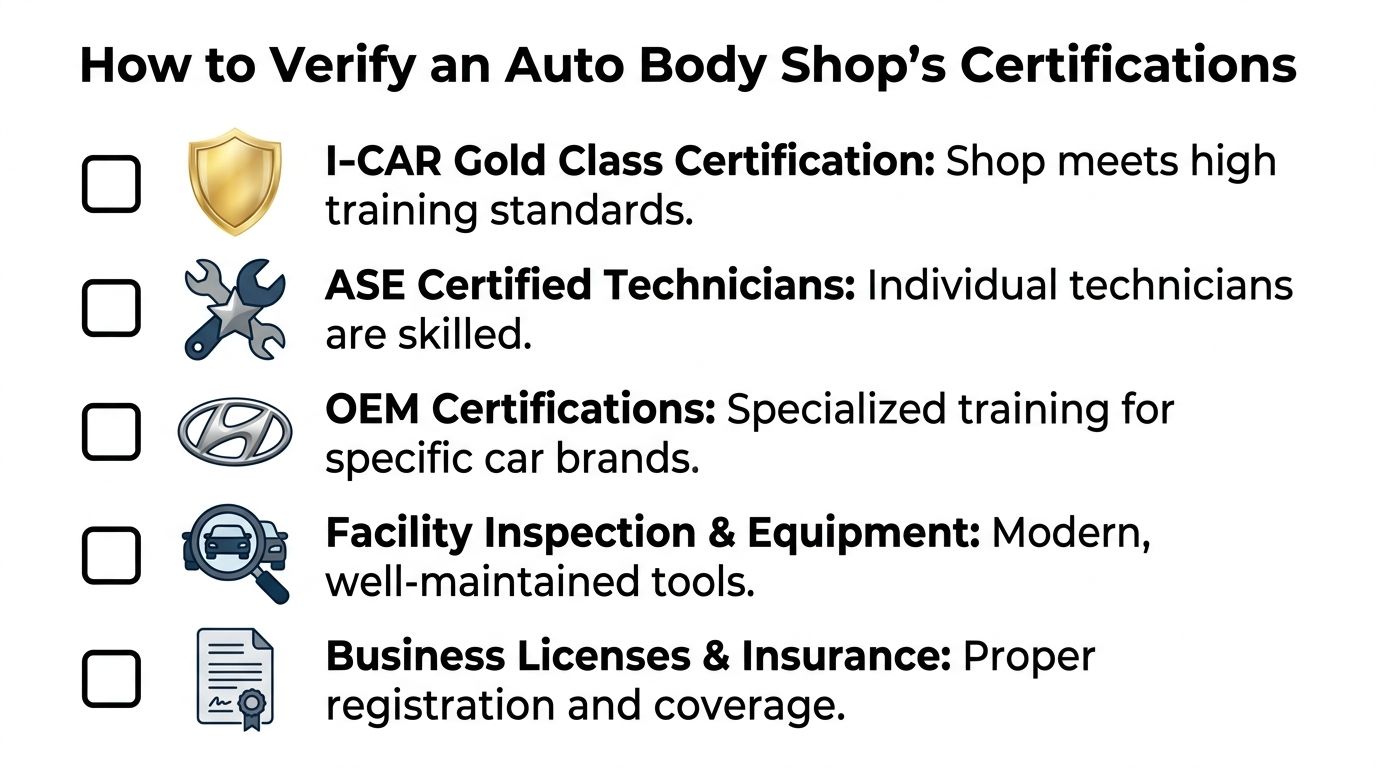
Why I-CAR Gold Class matters
If you hear I-CAR Gold Class, don’t treat it like a decorative logo.
Only about 10 to 15 percent of U.S. shops achieve I-CAR Gold Class certification, and that training is associated with 25% lower structural failure rates in post-repair crash tests compared with uncertified shops (Schneider Auto article citing I-CAR data and NHTSA benchmarks, 2025).
That matters because structure is not cosmetic work. If a repair affects how the vehicle manages crash energy, proper training matters in a very real way.
When you ask about certifications, don’t stop at “yes” or “no.” Ask:
- Is the shop currently Gold Class
- Do technicians train regularly on newer vehicle systems
- Does the shop follow manufacturer repair procedures when required
- Can they explain why those procedures matter on your vehicle
If you want a plain-language look at one credential customers ask about often, this page explains what it means when a body shop is AAA approved.
Certifications aren’t all the same
Some certifications apply to the shop. Others apply to individual technicians. Some show general skill. Others show training on specific repair methods.
A simple way to think about it is this:
| Credential | What it tells you |
|---|---|
| I-CAR Gold Class | The shop maintains ongoing collision repair training |
| AAA approval | An outside organization has reviewed business practices and customer standards |
| Manufacturer-related training | The shop may have vehicle-specific knowledge that matters on certain repairs |
| State licenses and insurance | The business is operating properly and responsibly |
No single badge answers every question. But a shop with no meaningful training credentials at all should make you cautious.
Ask what the certification means for your car
Customers often get tripped up. They see credentials on the wall, but they don’t ask how that changes the actual repair.
Ask direct questions like these:
- Who’s repairing my vehicle
- Does my vehicle have repair procedure requirements
- Will structural work, refinishing, and suspension checks all be documented
- If safety systems are involved, how is that handled after repair
If the answers are vague, rushed, or evasive, keep looking.
The right shop should be able to explain its qualifications in ordinary language. If it takes a sales speech to explain a credential, that’s not much help to you.
Navigate Insurance Claims and Repair Estimates
Insurance is where a lot of good decisions go sideways. People are stressed, they want the process moving, and they assume the insurer’s suggested shop is the one they have to use.
In California, you generally have the right to choose your repair facility under California Insurance Code § 758.5. The insurer can suggest a shop. They should not tell you that you must use one particular shop to get your claim handled. For guidance specific to your situation, check with your insurer or a licensed professional.
Understand insurance steering
When an insurer pressures a customer toward a preferred shop, that’s commonly called steering. Sometimes it’s subtle. Sometimes it sounds like, “You can go anywhere, but we can’t guarantee the work unless you use our shop,” or “That other shop charges too much,” before your vehicle has even been properly evaluated.
The California Autobody Association reported that steering complaints rose 15% in 2025, and 68% of surveyed drivers didn’t know they could choose their repair shop independently under California law (State Farm article referenced in the verified research angle, CAA 2025 Report).
That lack of awareness is exactly why people feel boxed in.
What to say if you feel pressured
You don’t need to argue. Stay calm and be direct.
You can say:
- I understand you have a preferred network, but I’m choosing my own repair shop.
- Please send the estimate and claim information to the shop I selected.
- If there’s a disagreement about repair scope, I want that explained in writing.
That usually changes the tone of the conversation.
You pay for insurance. You don’t give up your judgment when you file a claim.
If you’re comparing estimate formats and trying to make sense of what shops and insurers put on paper, this example of a collision estimate breakdown can help you see how line items are typically presented.
Read the estimate for repair quality, not just price
A body estimate is not just a price quote. It’s a repair plan in rough form.
Look for whether the estimate is detailed enough to show the shop inspected the vehicle. You want to see labor categories separated clearly, parts identified in a way that makes sense, and notes that show attention to repair steps instead of just a bottom-line number.
Ask these questions before you sign:
- Are the parts listed as OEM, aftermarket, or recycled
- What happens if hidden damage is found after disassembly
- Will the shop contact me before major changes
- Is there a written warranty on workmanship and paint
- Who communicates with the insurance company
A low initial estimate can mean the car hasn’t been fully disassembled yet. That part is normal. What matters is whether the shop explains that possibility upfront and documents supplements clearly.
Parts choice matters
Some repairs allow more flexibility than others. On certain jobs, aftermarket or recycled parts may be acceptable. On others, fit, finish, corrosion protection, or attachment points make the choice more important.
You don’t need to become a parts expert overnight. You do need the shop to explain what’s being used and why. If you want OEM parts, ask whether your policy allows them and whether the repair calls for them.
A careful shop won’t brush that question aside.
What to Look For During an In-Person Visit
Once you’ve narrowed your list, go see the shop. Five or ten minutes in person will tell you things the internet can’t.
Start with the front office. You’re not looking for fancy. You’re looking for organized. The staff should greet you, answer straightforward questions, and explain the next step without making you feel like you’re interrupting their day.
Watch how they inspect the car
A proper estimate starts with a real inspection. The estimator should look closely at the damaged area, ask how the incident happened, and mention the possibility of hidden damage when that’s realistic.
If somebody glances at the bumper from ten feet away and hands you a number, that’s not much of an inspection.
Look and listen for these signs:
- Clear walkaround: They point out visible damage and note what may need teardown to confirm.
- Repair logic: They can explain why a panel is repaired, replaced, or refinished.
- No rush to dismiss concerns: If you mention pulling, vibration, or suspension concerns, they take it seriously.
- Written process: They explain approvals, updates, and pickup steps.
If you suspect structural damage, it helps to understand the warning signs in plain language. This guide on how to tell if your car frame is bent covers what customers should watch for after an impact.
Ask about communication and warranty
Good repair work and poor communication make for a miserable experience. Ask how often they update customers and who your contact person will be.
Also ask for the warranty terms in writing. A solid shop should explain what its workmanship warranty covers, what paint warranty coverage looks like, and whether any exclusions apply.
If a shop is proud of its work, it won’t get slippery when you ask what happens if something needs to be corrected.
Look at the shop itself
You’re not inspecting for spotless floors. This is a repair business. But the place shouldn’t feel chaotic.
A well-run shop usually shows a few signs:
| What you see | What it often means |
|---|---|
| Orderly vehicles on site | Jobs are being tracked and staged properly |
| Staff who answer directly | Customer communication is taken seriously |
| Visible damage documentation | The shop works methodically |
| No pressure to sign immediately | They’re confident enough to let you decide |
Weighing Price Versus Quality for a Safe Repair
The cheapest estimate can cost you more trouble later. That’s the part people learn the hard way.
A very low number may mean the shop wrote a thin estimate, plans to use lower-grade parts where fit matters, or isn’t accounting for procedures needed on a modern vehicle. That doesn’t always show up on day one. It often shows up when the paint doesn’t match well, the panels don’t line up quite right, the car pulls, or a warning light stays on.
Why modern cars raise the stakes
This is especially true with newer vehicles. I-CAR reported that 42% of 2025 collisions involved vehicles with ADAS, and 75% of shops were not certified for the recalibration work those systems can require (Luxury Custom Garage article citing I-CAR 2025 Industry Pulse, 2025).
ADAS includes systems tied to cameras, sensors, and other features that affect how the vehicle interprets the road around it. When those systems are part of the repair picture, cost-cutting in the wrong place can turn into a safety problem.
A lower price isn’t automatically a better value
There’s nothing wrong with wanting a fair price. Everybody does. The trouble starts when “fair” gets confused with “lowest.”
A better comparison is this:
- Did both shops write the same repair scope
- Are they using the same type of parts
- Did both account for refinishing steps and related damage
- Are both equally qualified to handle your vehicle
If the answer is no, the numbers aren’t really comparable.
For example, one estimate may include a fuller inspection and anticipate necessary supplements later. Another may leave things out to make the total look attractive at the front counter.
What quality usually looks like
A quality repair usually includes careful disassembly when needed, attention to fit and finish, proper refinishing, and a willingness to explain changes if hidden damage turns up.
If you’ve already received an estimate and then heard the number might change after teardown, this explanation of why a repair estimate can go up after the shop starts working explains the process in plain terms.
A good estimate is honest before it is cheap.
When you’re deciding between shops, give extra weight to the one that explains the repair clearly, documents the work, and has the training to do it safely. That’s usually the better long-term choice.
Frequently Asked Questions About Auto Body Repair
Do I have to use the body shop my insurance company recommends
No. In California, you generally have the right to choose your own repair shop under California Insurance Code § 758.5. Your insurer can recommend a shop, but you can still select another facility and ask that claim communication be sent there.
Should I get more than one estimate
Yes, especially if the damage seems more than minor. Multiple estimates can help you see whether shops are looking at the same repair scope and whether one of them is leaving out important steps.
What should I ask about parts
Ask whether the estimate uses OEM, aftermarket, or recycled parts. Then ask why that choice was made and whether your policy or vehicle repair needs affect that decision.
How do I know if a shop can handle a newer car with safety systems
Ask about current training and whether the shop is prepared to address repair procedures related to modern vehicle systems. You want direct answers, not a vague promise that they “work on everything.”
Is a higher estimate always a bad sign
No. Sometimes a higher estimate reflects a more complete inspection or a better repair plan. What matters is whether the shop can explain the difference clearly and back it up in writing.
What does a good warranty look like
A good warranty should be written, easy to understand, and specific about what it covers. Ask about workmanship, paint, and what happens if a problem shows up after pickup.
Get a Clear Estimate and Professional Advice in Salinas
Learning how to find a good auto body shop comes down to a few steady habits. Start with trusted referrals, verify training, read the estimate carefully, and don’t let anyone rush you into a shop you didn’t choose. The right repair should protect your vehicle’s safety, appearance, and long-term value.
If you want a clear estimate or just want to talk through your options after an accident, Searson Collision Center is available to help. Call (831) 422-2460, visit 488 Brunken Ave, Salinas, CA 93901, or stop by Monday through Friday, 7:00 AM to 5:00 PM.
Sources
Fix Auto USA. "New Study Reveals How Consumers Choose an Auto Body Shop." 2023. https://fixautousa.com/blog/new-study-reveals-how-consumers-choose-an-auto-body-shop/
Schneider Auto. "6 Tips to Finding the Right Auto Body Shop." 2025. https://schneiderauto.net/blog/44-6-tips-to-finding-the-right-auto-body-shop
State Farm. "How to Choose an Auto Body Shop After an Accident." 2025. https://www.statefarm.com/simple-insights/auto-and-vehicles/how-to-choose-an-auto-body-shop-after-an-accident
Luxury Custom Garage. "The Ultimate Guide to Finding a Trustworthy Auto Body Shop." 2025. https://luxurycustomgarage.com/the-ultimate-guide-to-finding-a-trustworthy-auto-body-shop/