Direct Answer: Shops match faded paint by adjusting the mixed color to account for oxidation, then blending the repaired panel into adjacent panels so the difference disappears at normal viewing distance.
You get a door ding repaired, or a fender replaced after a minor collision, and the shop sprays it perfectly — but the new paint looks noticeably brighter than the rest of the car. It’s not the shop’s fault for mixing the color wrong. The problem started years ago, out in the sun on Highway 68 or parked on a Salinas street all summer.
Faded paint doesn’t have a code anymore. The paint code on your door jamb tells the shop what color your car was when it left the factory — not what it looks like today after years of UV exposure, heat, and oxidation. Matching to a faded car requires a different set of steps that most drivers don’t know about.
This article breaks down exactly what shops do when your car’s paint has aged, why some repairs still end up slightly off, and what you can do to get the best possible result.
Why Your Car’s Paint Code Isn’t Enough Anymore
Every car comes from the manufacturer with a specific paint formula — a code that tells a body shop exactly how to mix your color. For a brand-new car, that code is accurate within a very tight tolerance.
But paint fades. The Central Coast’s bright summers, salt air off Monterey Bay, and long stretches of direct sun along Highway 101 all accelerate oxidation. A white car that’s five years old can look noticeably warmer and duller than factory white. A dark blue can shift toward gray.
When a shop pulls up your paint code and mixes it straight, they’re reproducing what the factory put on the car in the first place — not what your car looks like right now. Spraying that fresh, accurate color next to oxidized panels creates a mismatch even if the formula is technically correct.
This is one of the most common reasons drivers are surprised when a repaired panel looks off. It’s not that the shop got the color wrong. It’s that they matched the wrong target. Understanding this is the first step to knowing what questions to ask before a paint job starts.
What Shops Actually Do to Match Faded Paint
A qualified shop has two main tools for closing the gap between fresh paint and aged paint: spectrophotometry and panel blending. Most shops use both together.
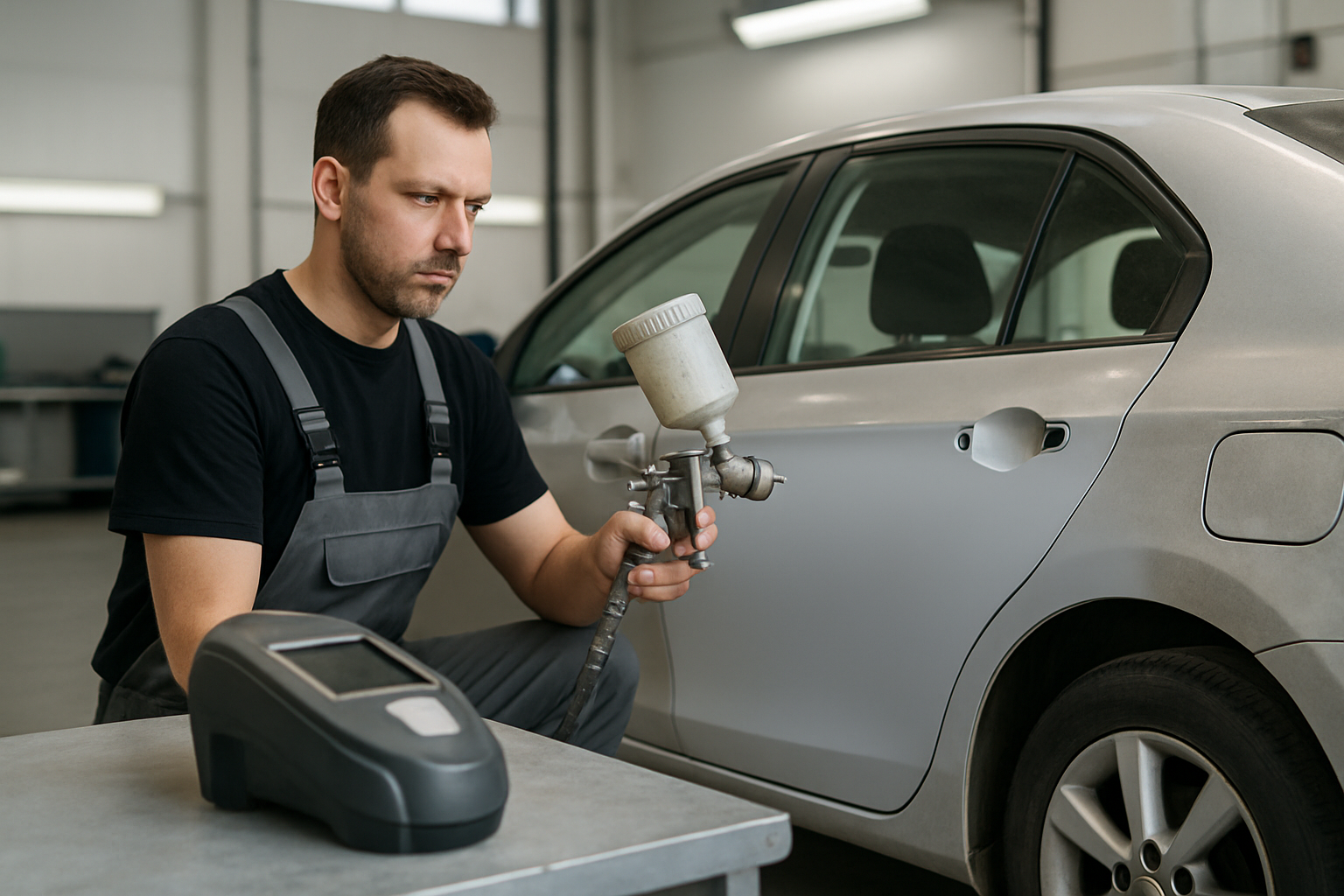
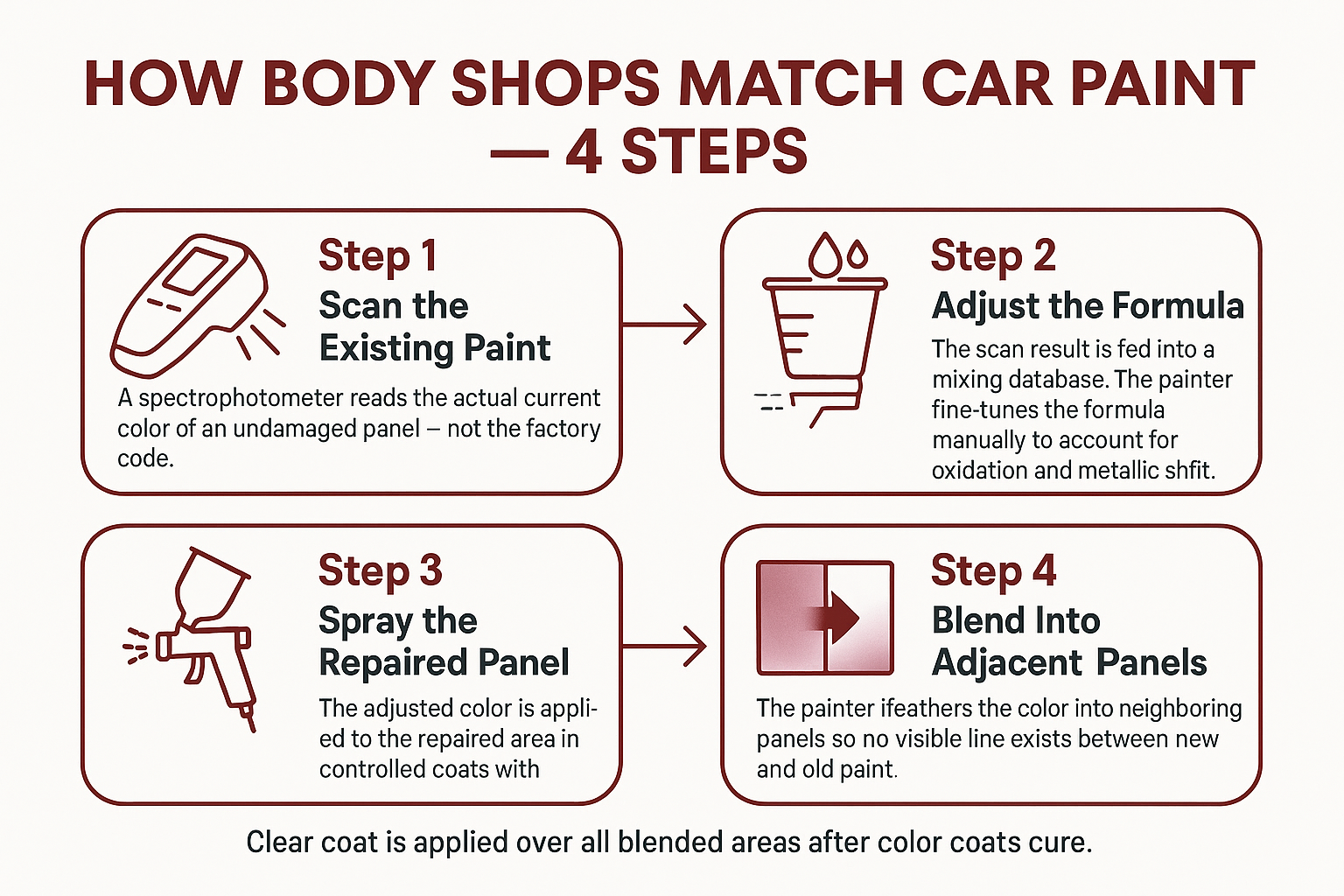
Spectrophotometry means using a handheld device called a spectrophotometer (sometimes called a color reader) that scans the existing paint on an undamaged panel of your car. It measures the actual color your paint is right now — not what it was at the factory. The device sends that reading to a paint-mixing database, which adjusts the formula to get as close to the current faded color as possible.
No scanner is perfect, though. Heavily oxidized paint, metallic flakes that have shifted over time, and pearlescent finishes with multiple layers all introduce variation that electronics can’t fully account for. A skilled painter will make additional manual adjustments after the scan.
Panel blending is the second part of the equation, and in many ways it’s more important. Instead of spraying only the repaired panel, the painter feathers the new color into the neighboring panels so the transition is invisible. The goal isn’t a perfect spot match — it’s a gradual blend that your eye can’t detect from a normal viewing distance.
For a sedan with a repaired rear quarter panel, that typically means blending into the trunk lid and the rear door. A car door paint job on a faded vehicle almost always requires blending into at least one adjacent panel to look right.
The combination of a scanner-adjusted formula plus proper blending is what separates a repair that looks factory-correct from one that leaves a visible line.
The 4-Step Process for Matching Faded Paint
This overview shows what happens between the initial color scan and the final clear coat on a vehicle with aged paint.
When Blending Still Isn’t Enough
There are situations where even perfect color matching and careful blending leave a visible difference. Knowing when this is likely to happen helps you set realistic expectations before the work starts.
Heavy oxidation is the biggest challenge. If the paint on your undamaged panels has oxidized to the point where it looks chalky or dull, a freshly painted and clear-coated panel will always look glossier — even if the color is a dead-on match. The new panel has fresh clear coat. The old panels don’t.
In these cases, a shop may recommend polishing or compounding the adjacent panels before blending. This removes a thin layer of oxidation and brings the surrounding paint closer in sheen to what the new panel will look like. It adds time and a modest cost — typically $50–$150 per panel at a Salinas-area shop — but it often makes the difference between a repair that looks seamless and one that looks patched.
Tri-stage and pearlescent finishes (common on vehicles like certain Honda Civic trims or Toyota Camry Special Edition packages) are genuinely harder to blend. These paints have three separate layers — base color, pearl or metallic mid-coat, and clear — each of which has to be matched and feathered correctly. A shop without experience on these finishes may struggle even with good equipment.
If you’re unsure whether your car’s finish falls into a harder-to-match category, the paint and body shops guide walks through what to look for when evaluating a shop’s finishing capabilities.
Paint Match Difficulty by Finish Type and Age
Not all paint is equally hard to match. Here’s a general reference for what to expect based on your car’s finish type and how much it’s aged.
| Finish Type | Age / Fade Level | Match Difficulty | Blending Usually Required? |
|---|---|---|---|
| Solid single-stage (white, black, gray) | Mild fade (1–4 years) | Low | Sometimes |
| Solid single-stage | Heavy fade (5+ years) | Moderate | Yes |
| Metallic base coat / clear coat | Mild fade | Moderate | Yes |
| Metallic base coat / clear coat | Heavy fade | High | Yes — plus panel polish |
| Tri-stage pearl or flake finish | Any age | High to Very High | Yes — all adjacent panels |
| Matte or satin factory finish | Any age | Very High | Specialty shop required |
What You Can Do Before You Drop the Car Off
You’re not helpless here. A few steps on your end make the shop’s job easier and improve your chances of a result you’re satisfied with.
Wash the car before the estimate. Sounds basic, but a dirty car makes it harder to accurately scan paint color and assess the degree of oxidation on adjacent panels. A clean car gives the estimator a realistic picture of what they’re working with.
Point out panels you’re worried about. If you know the roof has faded more than the doors, say so during the estimate. The painter needs to know which panels to use as the color reference point — and that decision matters.
Ask specifically about blending. Ask the shop whether the estimate includes blending into adjacent panels. Some estimates include it; some don’t. If yours doesn’t and you’re driving a car with noticeable fade, you’ll want to understand what the final result will look like.
If the repair stems from a collision, the car accident repair process guide has a solid breakdown of what to expect from estimate through delivery — including where paint decisions get made.
And if you’re paying out of pocket for a cosmetic repair rather than going through insurance, it’s worth reading about how repair bills are calculated before you approve the work. Paint blending adds real cost, but skipping it usually costs more in appearance.
Frequently Asked Questions About Matching Faded Car Paint
Will my insurance pay for blending into adjacent panels if my car’s paint is faded?
Usually yes — blending is considered part of a proper repair, and most insurance policies cover it when it’s necessary to match the existing finish. The adjuster may push back initially, but a certified shop can document why blending is required on a vehicle with faded paint. California Insurance Code § 758.5 supports your right to a repair that restores the vehicle to pre-loss condition, which includes visible finish quality. If you’re dealing with an insurer that’s questioning the blending line on an estimate, ask the shop to add a written explanation to the supplement.
How much does it cost to blend panels on a faded car in Salinas?
Panel blending typically runs $75–$200 per panel at most Monterey County shops, depending on panel size and finish complexity. A sedan with a repaired rear quarter panel that needs blending into the door and trunk lid might add $150–$350 to the total repair cost. On insurance claims, this is usually included in the estimate automatically by a certified shop.
Can a shop make my entire car look uniform again, or just the repaired area?
A body shop can make the repaired area blend smoothly into the panels directly next to it. But if the rest of the car has heavy oxidation and you’re only repairing one area, the overall car will still show age on the panels that weren’t touched. A full paint correction or respray is a separate conversation — and a separate cost. For a repaired panel, the realistic goal is that it matches the panels beside it well enough that you can’t see a line.
My car is dark blue and has faded a lot. Is it even worth repairing the paint?
Dark colors — especially blues and reds — are among the hardest to match once they’ve faded significantly because the color shift is dramatic and uneven across different panels. That doesn’t mean a repair isn’t worth doing. It means you should have a direct conversation with the shop before approving work, so you understand what the result will look like. A good shop will tell you honestly whether a seamless blend is achievable on your specific car.
Why does the repaired panel look shinier than the rest of the car even when the color matches?
Fresh clear coat is glossier than clear coat that’s been exposed to UV for years. Even when the color is a close match, the sheen difference can make the new panel stand out. Polishing the adjacent panels before or after blending closes most of that gap. This is exactly the scenario covered in depth at why your repaired panel doesn’t match the rest of the paint — worth reading if you’ve already had this experience.
How do I know if a shop actually has the right equipment to match my faded paint?
Ask whether they use a spectrophotometer for color scanning and whether their painters have experience with your specific finish type (especially if you have a pearl or tri-stage paint). Certifications like I-CAR Gold Class indicate that technicians receive ongoing training on exactly these skills. A shop that can’t answer those questions clearly is worth being cautious about.
Need an Honest Assessment of What Your Paint Repair Will Look Like?
Searson Collision Center has been matching paint on Salinas-area vehicles since 1963 — including plenty of cars that have spent years under the Central Coast sun. If you’re trying to figure out whether a faded car can be repaired in a way that actually looks right, the best starting point is an in-person estimate where a technician can scan your paint and tell you exactly what’s achievable. Call (831) 422-2460 or visit searsoncollisioncenter.com to schedule your free estimate.